Why Every Company Needs a Strong Corporate AI Strategy in 2026
Introduction
Artificial intelligence is evolving from a cutting-edge technology to a fundamental commercial capacity. In 2026, companies across industries are no longer asking whether they should use AI—they are focusing on how to implement it effectively, responsibly, and at scale.
A strong corporate AI strategy helps organizations identify valuable AI opportunities, manage risks, improve operations, and create long-term competitive advantages. Without a clear strategy, businesses may waste resources on disconnected AI projects that fail to deliver measurable results.
What Is a Corporate AI Strategy?
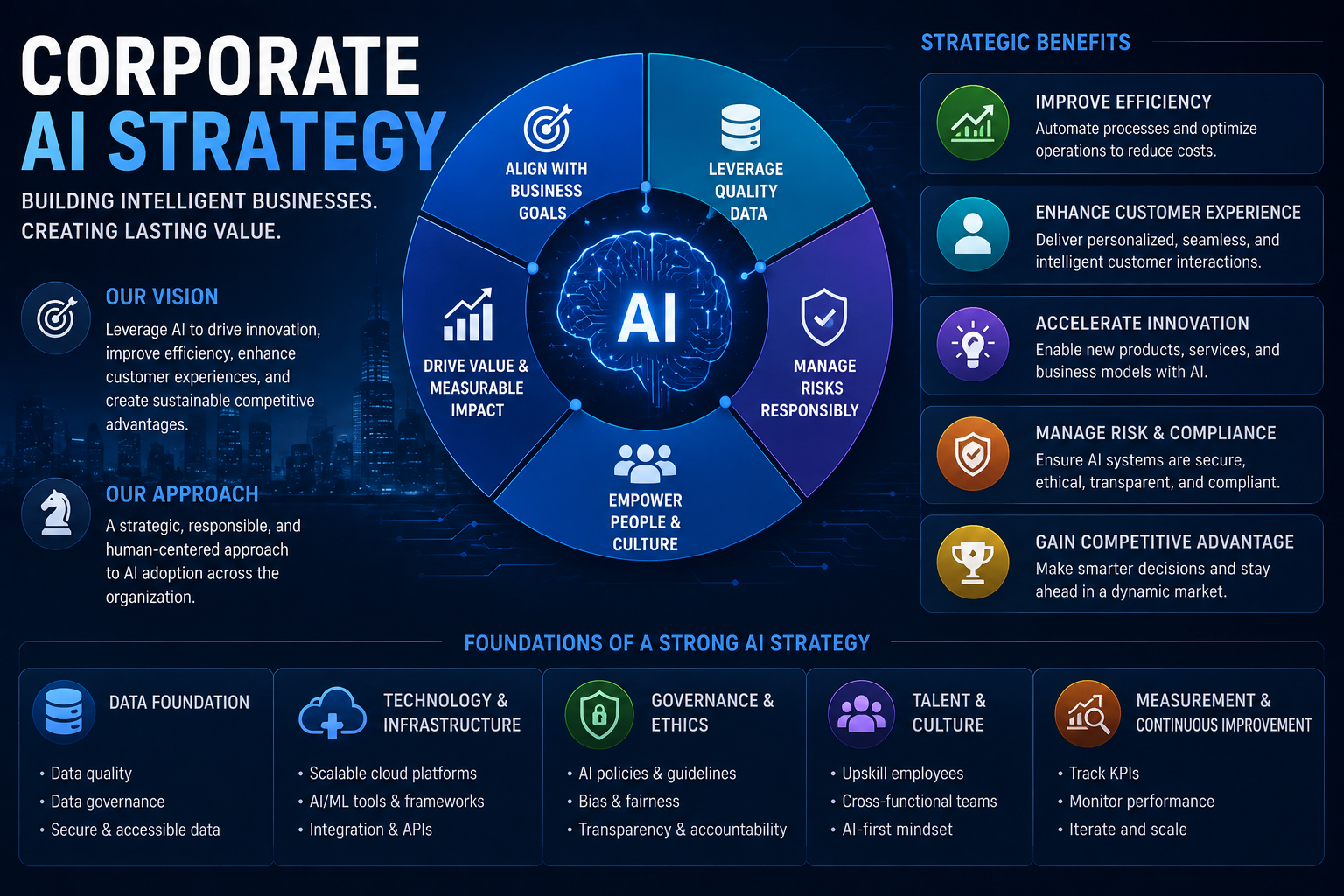
A corporate AI strategy is a structured plan that explains how an organization will use artificial intelligence to achieve business goals.
It typically includes:
- Business objectives for AI adoption
- Priority AI use cases
- Technology infrastructure requirements
- Data management plans
- Employee training programs
- AI governance policies
- Security and compliance frameworks
- Investment priorities
A successful strategy connects AI capabilities with real business outcomes rather than adopting technology simply because it is popular.

Why Companies Need a Strong AI Strategy
1. AI Is Becoming a Competitive Requirement
Companies that successfully integrate AI can improve:
- Productivity
- Customer experiences
- Decision-making
- Operational efficiency
- Innovation speed
Organizations without a clear AI roadmap may struggle to compete as AI becomes integrated into everyday business processes.
2. AI Investments Need Clear Business Goals
Many companies invest in AI tools without defining measurable objectives. This can lead to:
- Unused technology
- Duplicate projects
- High costs
- Limited business impact
A corporate AI strategy ensures investments are connected to specific goals, such as:
- Reducing operational costs
- Increasing revenue
- Improving customer service
- Automating repetitive work
- Creating new products
3. AI Helps Transform Business Operations
AI can improve internal processes across many departments.
Customer Service
AI-powered systems can:
- Answer customer questions
- Analyze feedback
- Personalize interactions
- Improve response times
Marketing
AI can support:
- Customer segmentation
- Content creation
- Campaign optimization
- Market analysis
Finance
AI can assist with:
- Fraud detection
- Forecasting
- Automated reporting
- Risk analysis
Human Resources
AI can improve:
- Recruitment processes
- Employee support
- Workforce planning
- Training recommendations
4. Data Becomes More Valuable With an AI Strategy
AI depends on high-quality data. A corporate AI strategy helps companies manage:
- Data collection
- Data quality
- Data security
- Data accessibility
- Data governance
Organizations with strong data foundations are better positioned to build reliable AI systems.
5. AI Governance Reduces Business Risks
As AI adoption grows, companies must address risks related to:
- Data privacy
- Security threats
- Algorithmic bias
- Incorrect AI outputs
- Regulatory compliance
A strong AI strategy includes governance practices such as:
- Human oversight
- AI usage guidelines
- Model monitoring
- Security controls
- Compliance reviews
6. AI Strategy Improves Employee Productivity
AI is increasingly becoming a workplace assistant rather than simply an automation tool.
Employees can use AI for:
- Research
- Document creation
- Data analysis
- Workflow automation
- Knowledge management
- Decision support
A good strategy focuses on helping employees use AI effectively while maintaining human expertise.
Key Elements of a Successful Corporate AI Strategy
1. Clear Business Objectives
The goals that businesses want AI to achieve should be determined.
Examples:
- Improve customer satisfaction
- Reduce processing time
- Increase sales efficiency
- Automate repetitive tasks
2. Prioritized AI Use Cases
Not every AI opportunity provides equal value.
Companies should prioritize projects based on:
- Business impact
- Implementation difficulty
- Available data
- Expected return on investment
3. Strong Technology Infrastructure
AI success requires:
- Cloud computing resources
- Data platforms
- AI development tools
- Integration capabilities
- Security systems
4. Employee AI Skills Development
Employers require workers who are familiar with AI.
Training areas may include:
- AI tools
- Data literacy
- Prompt engineering
- AI ethics
- Workflow automation
5. Continuous Improvement
AI strategies should evolve as technology changes.
Organizations should regularly review:
- AI performance
- Business results
- New opportunities
- Emerging risks
Common Mistakes Companies Make With AI
Treating AI as a Technology Project Only
AI transformation requires changes in:
- Business processes
- Employee workflows
- Organizational culture
Launching Too Many AI Experiments
Companies may create multiple AI pilots without a clear path to deployment.
A better approach is to focus on scalable projects with measurable value.
Ignoring Data Quality
Poor-quality data can produce unreliable AI results.
Strong data management should come before large-scale AI adoption.
Failing to Address Employee Adoption
AI tools succeed when employees understand how and why to use them.
Organizations should provide:
- Training
- Communication
- Support
- Clear AI policies
The Future of Corporate AI Strategy
In 2026 and beyond, leading companies will move from AI experimentation to AI integration.
Future corporate AI strategies will likely include:
- AI-powered business operations
- Autonomous AI agents
- Real-time decision systems
- Intelligent workflow automation
- AI-driven customer experiences
- Advanced predictive analytics
Companies that treat AI as a strategic capability—not just a software purchase—will be better positioned for long-term growth.
Conclusion
A strong corporate AI strategy is becoming essential for companies that want to compete in a rapidly changing business environment. By connecting AI investments with business objectives, improving data capabilities, managing risks, and empowering employees, organizations can turn artificial intelligence into measurable value.
In 2026, successful companies will not simply adopt AI tools—they will build thoughtful strategies that make AI a core part of how they operate, innovate, and grow.



Post Comment