ChatGPT Ranking: How to Rank Higher in AI Search in 2026
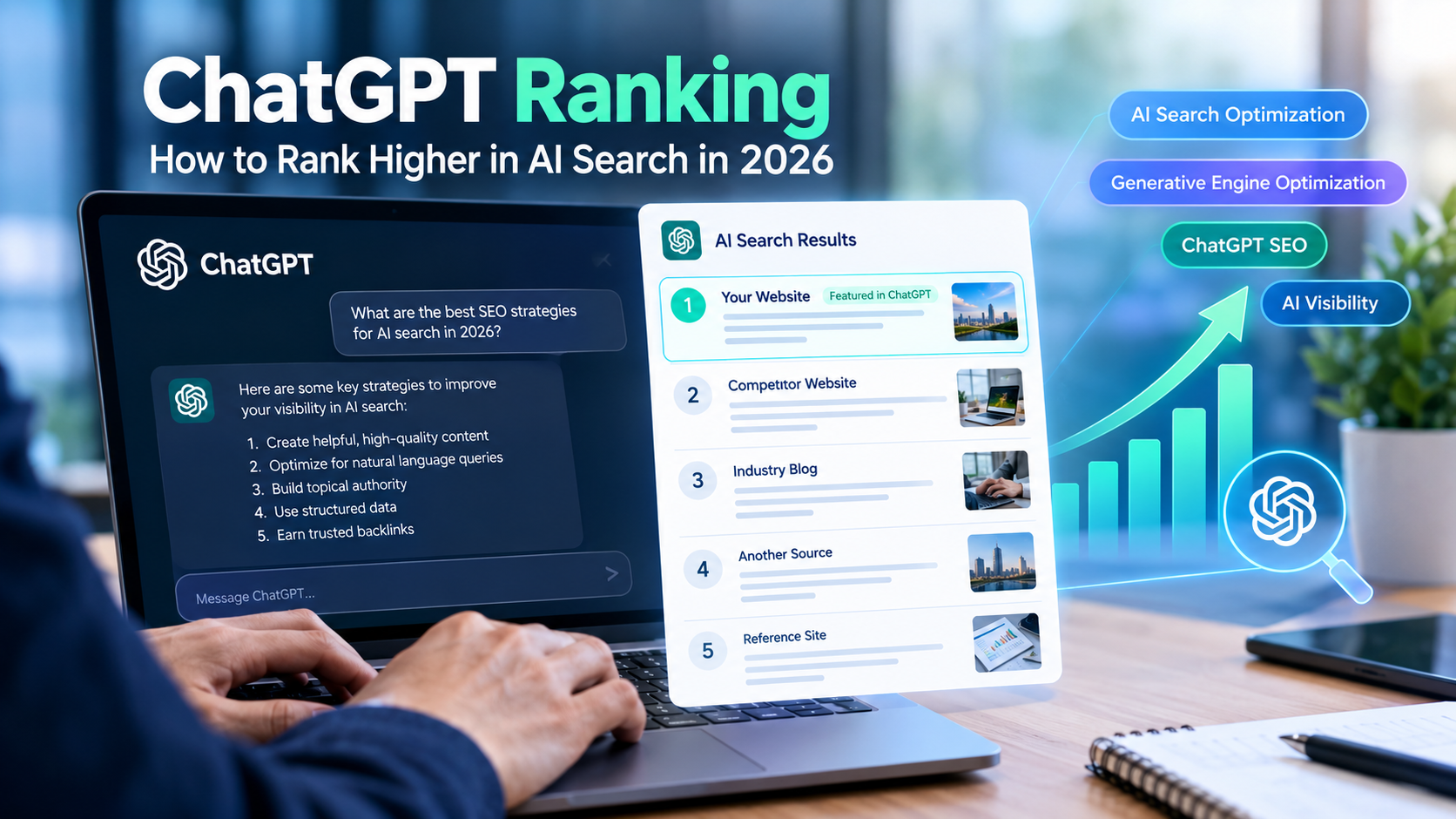
Search is changing rapidly in 2026. People are no longer relying only on traditional search engines to find information, products, services, and answers. AI platforms such as ChatGPT Ranking are increasingly becoming part of the way users discover and evaluate information.
This shift has created a new area of digital marketing known as AI search optimization or Generative Engine Optimization (GEO). For businesses, publishers, and website owners, understanding how ChatGPT ranking works can help improve visibility when users ask AI systems questions related to their products, services, or expertise.
What Is ChatGPT Ranking?
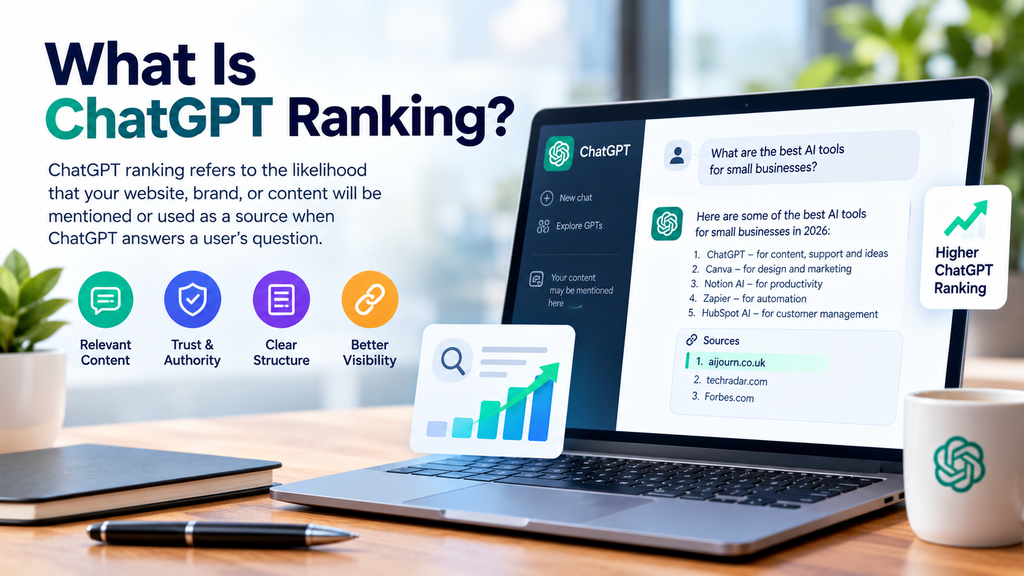
ChatGPT ranking refers to the likelihood that a website, brand, product, or piece of content will be mentioned or used as a source when ChatGPT answers a user’s question.
It is important to understand that ChatGPT does not work exactly like a traditional search engine. There is no simple public ranking formula where website owners can enter a keyword and receive a guaranteed position.
Depending on the ChatGPT experience and whether web search is being used, responses can be generated from the model’s knowledge, retrieved web information, or a combination of sources.
Therefore, the goal should not simply be to “rank #1 in ChatGPT.” Instead, businesses should create content that is accurate, useful, trustworthy, easy to understand, and discoverable.
Why ChatGPT Ranking Matters in 2026
AI-powered search is changing how users interact with online information.
Instead of searching for several individual pages, a user may ask a conversational question such as:
“What AI tools are best for small businesses?”
An AI search experience can potentially provide a summarized answer instead of requiring the user to open multiple search results.
For publishers and businesses, this creates another opportunity for visibility. Content that is useful to users and well-supported by credible information may have a better chance of being considered in AI-generated answers.
How to Improve ChatGPT Ranking
1. Create Helpful, Original Content
The foundation of AI search visibility is high-quality content.
Avoid creating pages that simply repeat information found on dozens of other websites. Instead, provide original explanations, examples, comparisons, data, expert insights, and practical advice.
For example, instead of publishing a generic article about AI accounting software, create a detailed guide covering:
- Key features
- Pricing considerations
- Use cases
- Advantages and limitations
- Implementation steps
- Security considerations
- Examples for different business sizes
The more useful the page is for a real reader, the stronger its overall content value.
2. Answer Specific Questions
AI search is highly conversational. Users frequently ask complete questions rather than entering only short keywords.
Build content around questions your target audience actually asks.
Examples include:
- What is ChatGPT SEO?
- How does AI search work?
- How can a website improve AI visibility?
- What is Generative Engine Optimization?
- How can businesses optimize content for AI search?
Use clear headings and answer important questions directly.
3. Use Clear Content Structure
Well-structured content is easier for both users and search systems to understand.
Use:
- H1 for the main title
- H2 for major sections
- H3 for supporting topics
- Short paragraphs
- Bullet points
- Numbered lists
- Tables when useful
- Clear definitions
Avoid unnecessary repetition and overly complicated sentences.
4. Build Topical Authority
Publishing one article about a subject may not be enough to demonstrate expertise.
For example, a technology website could create a content cluster around AI search:
- ChatGPT SEO
- ChatGPT ranking
- AI search optimization
- Generative Engine Optimization
- AI content optimization
- AI search visibility
- Traditional SEO vs. AI SEO
- How AI search affects publishers
These related articles can be connected through relevant internal links.
This helps users navigate the subject and establishes a stronger topical structure for the website.
5. Strengthen Your Website’s Trust Signals
Trust is particularly important when publishing information that users may rely on.
Make your website transparent by providing:
- An About page
- Contact information
- Author information
- Editorial guidelines where appropriate
- Clear publication and update dates
- References for factual claims
- Accurate business information
For specialized subjects, demonstrate relevant expertise and cite reliable sources when making important claims.
6. Use Reliable Sources
When discussing statistics, research, market trends, or technical claims, use credible sources.
For example, you can reference:
- Government organizations
- Universities
- Research institutions
- Industry organizations
- Official company documentation
- Peer-reviewed research
- Established publications
Do not add citations simply to make an article look authoritative. Sources should genuinely support the claims being made.
7. Keep Important Information Easy to Find
Do not hide the primary answer deep inside a long introduction.
For an article targeting “ChatGPT ranking,” explain the concept near the beginning and then expand on it.
A useful structure might be:
Definition → Why it matters → Ranking factors → Optimization strategies → Common mistakes → FAQ → Conclusion
This format makes the article easier for readers to scan.
8. Optimize for Traditional SEO Too
AI search optimization does not mean abandoning traditional SEO.
Technical SEO remains important because websites still need to be accessible, crawlable, fast, and understandable.
Continue focusing on:
- Relevant keywords
- Search intent
- Page titles
- Meta descriptions
- Internal links
- Structured content
- Mobile usability
- Page performance
- Indexability
- High-quality backlinks
A strong SEO foundation can complement an AI search strategy.
ChatGPT Ranking vs. Traditional Google Ranking
ChatGPT and traditional search engines should not be treated as identical systems.
Traditional search generally presents a list of search results that users can select from. AI search can instead synthesize information and provide a conversational response.
This means businesses should consider two related goals:
Traditional SEO: Make pages discoverable and competitive in conventional search results.
AI search optimization: Make information clear, useful, authoritative, and easy for AI-powered search experiences to interpret and potentially reference.
The two approaches overlap significantly, but they are not exactly the same.
Common ChatGPT SEO Mistakes
Keyword Stuffing
Repeating “ChatGPT ranking” dozens of times does not automatically improve visibility.
Use keywords naturally and focus on answering the reader’s intent.
Publishing Low-Value AI Content
Using AI to generate large quantities of generic content without fact-checking, editing, or adding original value can produce weak pages.
AI can assist with research and drafting, but human review and editorial quality remain important.
Ignoring Accuracy
AI search users expect useful answers. Incorrect statistics, outdated information, and unsupported claims can reduce the credibility of a website.
Review important information regularly.
Creating Content Only for Algorithms
Content should primarily solve a user’s problem.
A page designed entirely around manipulating search systems can become difficult to read and less useful.
How to Measure AI Search Visibility
Measuring ChatGPT visibility can be more complicated than tracking a traditional keyword position.
Website owners can monitor:
- Brand mentions in AI search experiences
- Referral traffic from AI platforms when identifiable
- Organic search performance
- Branded search growth
- Mentions and citations of published content
- Engagement on pages appearing in AI-related searches
Because AI-generated responses can vary depending on the query, user context, system, and available information, a single “ChatGPT ranking position” should not be treated as a universal metric.
ChatGPT Ranking Checklist for 2026
Before publishing an article, check the following:
- Is the main topic clearly defined?
- Does the article satisfy search intent?
- Is the information accurate?
- Are important claims supported by reliable sources?
- Does the page provide original value?
- Are headings descriptive?
- Are paragraphs easy to scan?
- Are relevant internal links included?
- Is the website technically accessible?
- Are author and website trust signals clear?
- Has outdated information been reviewed?
- Does the content answer real user questions?
The Future of ChatGPT Ranking
AI search is still developing, so there is no permanent formula for achieving visibility in ChatGPT.
Instead of chasing a single ranking trick, businesses should build a long-term content strategy around quality, authority, accuracy, relevance, and user value.
Websites that consistently publish useful information and maintain a strong technical and editorial foundation can be better positioned for the changing search landscape.
Conclusion
ChatGPT ranking represents a new consideration for publishers and businesses as users increasingly interact with AI-powered search experiences.
There is no guaranteed method for making a website appear in every ChatGPT answer. However, businesses can improve their overall discoverability by creating helpful content, answering specific questions, developing topical authority, using trustworthy sources, maintaining technical SEO, and providing clear information.
In 2026, the most sustainable approach is not simply optimizing for an AI system. It is creating content that is genuinely valuable to the people using those systems.



Post Comment