AI in Commercial Real Estate: How Technology Is Reshaping the Property Market

Artificial intelligence (AI) is changing how businesses analyze, manage, and invest in commercial real estate. AI in Commercial Real Estate property valuation and market research to tenant management and predictive maintenance, AI is helping real estate professionals make faster, data-driven decisions.
Commercial properties generate large amounts of information, including rental data, occupancy rates, market trends, maintenance records, financial information, and tenant behavior. AI can analyze these datasets and identify patterns that may be difficult to discover through traditional methods.
As the commercial real estate industry becomes increasingly data-driven, AI is becoming an important technology for property owners, investors, developers, brokers, and facility managers.
What Is AI in Commercial Real Estate?
AI in commercial real estate refers to the use of artificial intelligence technologies to analyze property data, automate processes, forecast market conditions, and support business decisions.
Machine learning, predictive analytics, natural language processing, computer vision, and AI-powered automation can all be applied to different areas of commercial property operations.
For example, an AI system can analyze historical rental prices, local economic indicators, occupancy rates, and property characteristics to help estimate potential rental or investment opportunities.
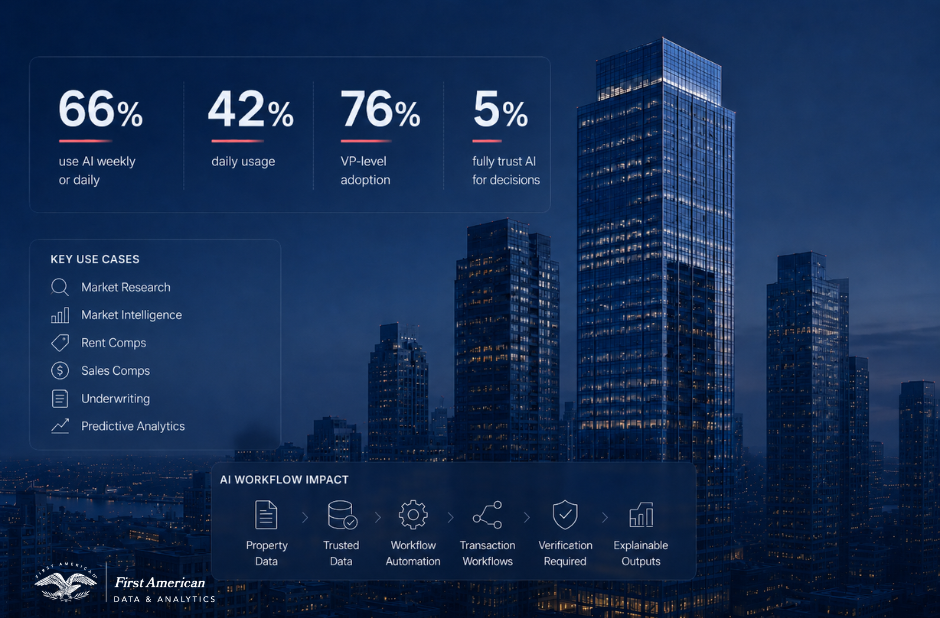
How AI Is Transforming Commercial Real Estate
1. Smarter Property Valuation
Property valuation traditionally depends on factors such as location, property condition, comparable sales, rental income, and market conditions.
AI can process large datasets from multiple sources and identify relationships between these factors. This can help real estate professionals create more data-driven valuation models.
AI does not replace professional valuation expertise, but it can provide additional analytical information that supports the decision-making process.
2. Predictive Market Analysis
Commercial real estate markets can change because of economic conditions, interest rates, employment trends, population growth, business activity, and local development.
AI-powered analytics can examine historical and current data to identify market patterns. Investors and property companies can use these insights to monitor potential changes in demand, rents, occupancy, and investment conditions.
This makes predictive analytics an increasingly useful part of commercial real estate research.
3. Improved Property Management
Managing commercial properties involves many repetitive tasks. These can include maintenance requests, inspections, tenant communication, energy monitoring, and operational reporting.
AI-powered systems can automate some of these processes and organize property information in one place.
For example, an intelligent property management platform may identify recurring maintenance issues and alert managers before they become larger operational problems.
4. Predictive Maintenance
Unexpected equipment failures can increase operating costs and disrupt tenants.
AI can analyze information from building systems, sensors, maintenance records, and equipment performance. When unusual patterns appear, the system can potentially alert facility managers that maintenance may be required.
Predictive maintenance can help organizations move from a reactive approach toward a more proactive maintenance strategy.
5. Better Tenant Experience
Tenant satisfaction is important for commercial property owners because it can influence retention and long-term occupancy.
AI can support tenant services through automated communication, virtual assistants, service-request systems, and personalized building experiences.
For example, an AI chatbot can answer common questions about building facilities, access, parking, maintenance requests, or operating hours.
6. AI-Powered Property Search
Finding suitable commercial properties can involve reviewing large numbers of listings and datasets.
AI-powered search tools can analyze factors such as location, property type, size, price, rental potential, transportation access, and nearby businesses.
This can make property research more efficient by helping users identify properties that match specific investment or business requirements.
AI and Commercial Real Estate Investment
Investment decisions often require extensive research. Investors may need to compare property prices, rental income, vacancy rates, local market conditions, development projects, and economic indicators.
AI can bring these data points together and help users analyze them more efficiently.
For example, an AI analytics platform could compare several commercial properties based on historical rental performance, occupancy trends, operating expenses, and other available information.
However, AI-generated insights should be treated as analytical support rather than a guaranteed prediction of investment performance.
AI for Commercial Property Marketing
AI is also changing how commercial properties are marketed.
Real estate businesses can use AI to analyze potential tenants, create property descriptions, personalize marketing campaigns, and identify audience segments.
AI tools can also help generate marketing content, analyze engagement data, and improve communication with prospective tenants or buyers.
When combined with accurate property information, these technologies can make commercial real estate marketing more targeted and efficient.
The Importance of Data Quality
AI is only as useful as the data it receives.
Commercial real estate companies often work with information from different sources, including property management systems, financial databases, public records, market reports, building sensors, and customer platforms.
If this information is outdated, incomplete, duplicated, or inaccurate, AI models may produce unreliable results.
Therefore, businesses adopting AI should focus on data quality, standardization, security, and governance alongside the technology itself.
Benefits of AI in Commercial Real Estate
AI can provide several potential benefits across commercial property operations:
- Faster analysis of large datasets
- More efficient property research
- Automated administrative processes
- Improved maintenance planning
- Better tenant communication
- Data-driven market analysis
- More efficient property management
- Improved operational monitoring
- Enhanced marketing personalization
- Greater visibility into property performance
The actual benefits depend on the quality of the data, the AI system being used, and how effectively the technology is integrated into existing workflows.
Challenges of Using AI in Commercial Real Estate
Despite its potential, AI adoption comes with challenges.
Data Privacy and Security
Commercial property systems can contain sensitive financial, tenant, and operational information. Companies need appropriate security controls when collecting, storing, and processing this data.
Data Accuracy
Poor-quality data can reduce the reliability of AI-generated analysis. Organizations may need to clean and standardize historical information before implementing advanced AI systems.
Integration With Existing Systems
Real estate companies may already use multiple software platforms for accounting, property management, customer relationships, maintenance, and leasing.
Connecting AI tools with these systems can require technical planning and investment.
Human Oversight
AI can support analysis, but important commercial real estate decisions may still require human expertise. Professionals can consider legal, financial, operational, and market factors that may not be fully represented in a dataset.
The Future of AI in Commercial Real Estate
The role of AI in commercial real estate is likely to expand as property companies collect more digital data and adopt connected building technologies.
Future applications may include more advanced building automation, real-time property analytics, AI-powered leasing systems, digital twins, intelligent energy management, and increasingly personalized tenant services.
The combination of AI, Internet of Things (IoT) devices, cloud computing, and real-time analytics could create more connected and data-driven commercial buildings.
However, successful adoption will depend not only on advanced AI models but also on reliable data infrastructure and responsible implementation.
Final Thoughts
AI in commercial real estate is reshaping how property professionals collect information, analyze markets, manage buildings, communicate with tenants, and evaluate opportunities.
The technology can improve efficiency and provide new analytical capabilities, but AI should work alongside reliable data, professional expertise, and appropriate oversight.
As commercial real estate becomes increasingly digital, organizations that build strong data foundations may be better positioned to take advantage of emerging AI capabilities.
The future of commercial real estate is not simply about using AI. It is about combining AI, high-quality data, human expertise, and smart property technology to create more informed and efficient real estate operations.


Post Comment