AI Governance Strategies: A Practical Framework for Enterprise AI

Introduction
Artificial intelligence (AI) is transforming how organization’s operate, enabling faster decision-making, improved customer experiences, and greater operational efficiency. As enterprises deploy AI across multiple departments, governance becomes essential to ensure AI systems remain secure, ethical, transparent, and compliant with regulations. Without a clear governance framework, businesses risk data breaches, biased algorithms, regulatory penalties, and loss of stakeholder trust.
In 2026, AI governance is no longer just an IT concern—it is a strategic business priority. A practical AI governance framework helps organisations balance innovation with accountability, ensuring AI delivers value while managing risks effectively.
What Is AI Governance?
AI governance is the set of policies, processes, standards, and technologies that guide the responsible development, deployment, monitoring, and management of artificial intelligence systems throughout their lifecycle.
An effective governance framework ensures that AI solutions are:
- Ethical
- Transparent
- Secure
- Fair
- Compliant with regulations
- Reliable
- Accountable
- Aligned with business objectives

Why AI Governance Matters for Enterprises
As AI adoption accelerates, organisations face growing challenges related to compliance, cybersecurity, and operational risk.
Strong AI governance helps businesses:
- Reduce regulatory risks
- Improve decision-making
- Protect sensitive data
- Build customer trust
- Prevent biased AI outcomes
- Enhance operational efficiency
- Support responsible innovation
- Increase AI adoption confidence
Governance enables businesses to scale AI responsibly without sacrificing innovation.
Core Principles of AI Governance
A successful enterprise AI governance strategy should be built on several key principles.
Accountability
Every AI system should have clearly assigned owners responsible for its development, deployment, maintenance, and performance.
Responsibilities include:
- Risk management
- Compliance oversight
- Model approval
- Incident response
- Performance monitoring
Transparency
AI decisions should be understandable to users, regulators, and internal stakeholders.
Transparency includes:
- Model documentation
- Decision explanations
- Data source tracking
- Audit trails
- Reporting mechanisms
Explainable AI builds trust and supports regulatory compliance.
Fairness
AI models should minimise bias and ensure equitable outcomes across different user groups.
Best practices include:
- Bias testing
- Diverse training datasets
- Regular model evaluations
- Independent audits
- Continuous monitoring
Privacy and Data Protection
Enterprise AI depends on high-quality data, making privacy protection a critical priority.
Governance policies should address:
- Data encryption
- Access controls
- Consent management
- Data retention
- Secure storage
- Data minimisation
Security
AI systems must be protected against cyber threats, unauthorised access, and model manipulation.
Security measures include:
- Multi-factor authentication
- Continuous monitoring
- Threat detection
- Vulnerability assessments
- Secure APIs
- Network protection
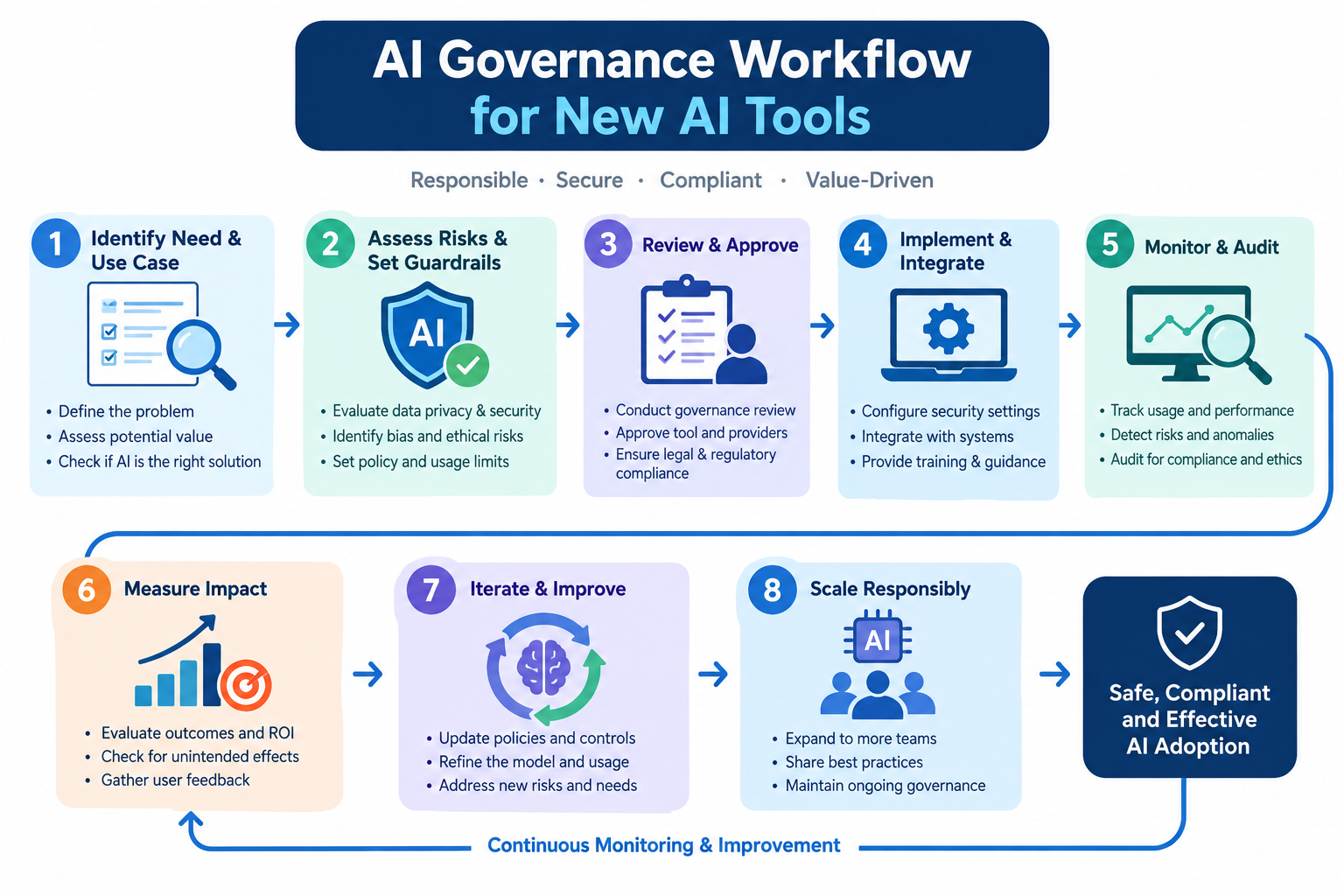
Building an Enterprise AI Governance Framework
Step 1: Define Governance Objectives
Organisations should identify why governance is needed and align AI initiatives with business goals.
Common objectives include:
- Regulatory compliance
- Ethical AI development
- Risk reduction
- Business growth
- Customer trust
- Operational efficiency
Step 2: Create AI Policies
Policies provide consistent guidance across the organisation.
Key policy areas include:
- Data usage
- Model development
- Human oversight
- Vendor management
- AI procurement
- Responsible AI principles
Step 3: Establish Governance Roles
Successful governance requires cross-functional collaboration.
Typical stakeholders include:
- Executive leadership
- AI governance committee
- Data scientists
- IT security teams
- Legal and compliance departments
- Risk management teams
- Business unit leaders
- Internal auditors
Each stakeholder should have clearly defined responsibilities.
Step 4: Manage Data Quality
AI performance depends on reliable, accurate, and representative data.
Data governance should focus on:
- Data validation
- Quality assurance
- Metadata management
- Data lineage
- Version control
- Access permissions
Step 5: Govern the AI Model Lifecycle
Governance should cover every stage of the AI lifecycle.
Planning
- Define objectives
- Assess risks
- Identify compliance requirements
Development
- Validate training data
- Test algorithms
- Document model assumptions
Deployment
- Perform security reviews
- Obtain approvals
- Monitor production readiness
Monitoring
- Detect performance drift
- Evaluate accuracy
- Identify bias
- Track incidents
Retirement
- Archive documentation
- Securely remove outdated models
- Preserve audit records
AI Risk Management
Enterprises should proactively identify and mitigate AI-related risks.
Common risks include:
- Algorithmic bias
- Data privacy violations
- Cybersecurity threats
- Regulatory non-compliance
- Model drift
- Inaccurate predictions
- Intellectual property concerns
- Third-party AI risks
Risk assessments should be performed regularly.
Regulatory Compliance
AI regulations continue to evolve across industries and jurisdictions.
Organisations should monitor requirements related to:
- Data protection
- Consumer rights
- Industry-specific regulations
- AI transparency
- Record keeping
- Automated decision-making
- Security standards
Maintaining comprehensive documentation supports audits and regulatory reviews.
Human Oversight
AI should support—not replace—human decision-making in high-impact situations.
Human oversight includes:
- Reviewing critical decisions
- Approving automated actions
- Investigating AI incidents
- Handling exceptions
- Validating model outputs
Keeping people involved reduces operational and ethical risks.
Measuring AI Governance Success
Key performance indicators (KPIs) help organisations evaluate governance effectiveness.
Examples include:
- Compliance audit results
- Model accuracy
- Bias detection rates
- Incident response times
- AI adoption rates
- Customer trust metrics
- Data quality scores
- Risk reduction outcomes
- Time to deploy compliant models
Regular reporting helps leadership monitor progress and identify areas for improvement.
Emerging Trends in AI Governance
Enterprise AI governance is rapidly evolving. Key trends in 2026 include:
- Automated AI compliance monitoring
- AI governance platforms
- Continuous model auditing
- Explainable AI (XAI)
- Generative AI governance
- AI risk scoring
- Real-time policy enforcement
- Responsible AI certification
- Privacy-enhancing technologies
- AI governance integrated with enterprise risk management
These innovations help organisations manage AI at scale while maintaining trust and compliance.
Best Practices for Implementing AI Governance
To establish a strong governance programme:
- Develop a clear AI governance strategy aligned with business objectives.
- Create documented policies for AI development, deployment, and monitoring.
- Form a cross-functional governance committee with executive support.
- Implement rigorous data governance and quality controls.
- Conduct regular bias, security, and compliance assessments.
- Maintain detailed documentation and audit trails.
- Monitor AI systems continuously for performance, fairness, and security.
- Train employees on responsible AI practices and governance responsibilities.
- Review and update governance frameworks as technology and regulations evolve.
Benefits of Effective AI Governance
A well-designed governance framework delivers long-term value by:
- Building trust among customers and stakeholders
- Reducing legal and regulatory risks
- Improving AI reliability and accuracy
- Strengthening cybersecurity and data protection
- Accelerating responsible AI adoption
- Enhancing operational efficiency
- Supporting ethical innovation
- Increasing confidence in AI-driven decisions
- Enabling scalable enterprise AI initiatives
Conclusion
AI governance is the foundation of responsible enterprise AI. As organisations scale artificial intelligence across business functions, a practical governance framework ensures that AI systems remain ethical, transparent, secure, and compliant while continuing to deliver measurable business value. By establishing clear policies, assigning accountability, managing risks, and maintaining human oversight, enterprises can innovate with confidence and build AI systems that are trusted by employees, customers, and regulators. In 2026 and beyond, organisations with strong AI governance strategies will be better positioned to achieve sustainable growth and long-term competitive advantage.


Post Comment