AI Agents in Finance: Everything You Need to Know in 2026
Introduction
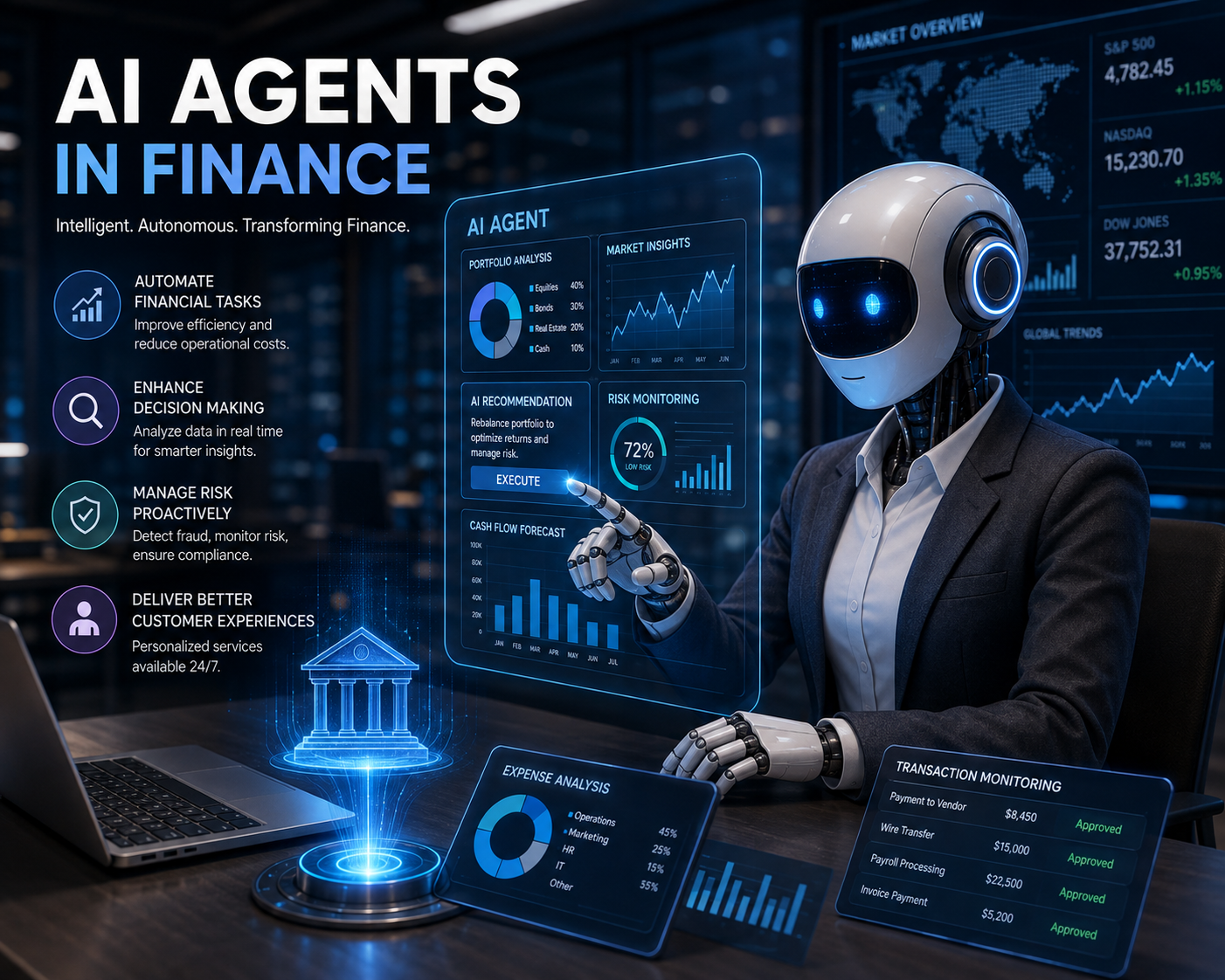
Artificial intelligence is transforming the financial industry, and one of the most significant innovations is the rise of AI Agents in Finance. Unlike traditional AI tools that perform single tasks, AI agents can reason, plan, make decisions, and execute complex financial workflows with minimal human intervention. These intelligent systems are helping banks, investment firms, insurance companies, fintech startups, and enterprises automate operations, improve customer experiences, detect fraud, and make faster, data-driven decisions.
In 2026, AI agents are becoming an essential part of modern financial services. Powered by large language models (LLMs), machine learning, natural language processing (NLP), and advanced analytics, they can manage repetitive tasks, analyze massive datasets, assist financial professionals, and continuously learn from new information.
This guide explores what AI agents in finance are, how they work, their benefits, real-world applications, implementation challenges, and future trends.
What Are AI Agents in Finance?
AI Agents in Finance are intelligent software systems designed to perform financial tasks autonomously or with limited human supervision. They can gather information, analyze financial data, make recommendations, automate workflows, and interact with users through natural language.
Unlike traditional automation software, AI agents can:
- Understand complex financial queries
- Analyze structured and unstructured data
- Learn from historical information
- Make intelligent recommendations
- Execute predefined financial workflows
- Adapt to changing market conditions
These capabilities make AI agents valuable for improving efficiency and supporting better financial decision-making.

How AI Agents Work
AI agents combine multiple advanced technologies to perform financial tasks effectively.
Large Language Models (LLMs)
LLMs enable AI agents to understand natural language, summarize financial reports, answer customer questions, and generate business insights.
Machine Learning
Machine learning algorithms analyze historical financial data to identify trends, predict outcomes, and improve decision-making over time.
Natural Language Processing (NLP)
NLP allows AI agents to interpret contracts, financial statements, customer requests, emails, and regulatory documents.
Predictive Analytics
AI agents forecast market movements, customer behavior, financial risks, and investment opportunities using predictive models.
Workflow Automation
AI agents automate repetitive financial processes such as approvals, document processing, compliance checks, and reporting.
Key Features of AI Agents in Finance
Modern AI financial agents often include:
- Intelligent financial analysis
- Automated reporting
- Customer service chatbots
- Fraud detection
- Risk assessment
- Portfolio monitoring
- Regulatory compliance monitoring
- Financial forecasting
- Personalized financial recommendations
- Document processing
- Workflow automation
- Real-time alerts
- API integration
- Secure data management
Benefits of AI Agents in Finance
Faster Decision-Making
AI agents process large volumes of financial data within seconds, allowing organizations to respond quickly to changing market conditions.
Improved Operational Efficiency
Routine administrative tasks are automated, enabling finance professionals to focus on strategic initiatives.
Enhanced Fraud Detection
AI continuously monitors transactions to identify suspicious activities and reduce financial crime.
Better Customer Experience
Virtual financial assistants provide instant support, personalized recommendations, and faster responses.
Reduced Operational Costs
Automation decreases manual workloads, minimizes errors, and lowers operating expenses.
More Accurate Risk Management
AI agents identify potential risks earlier by analyzing market trends, transaction patterns, and customer behavior.
Real-World Applications
Banking
Banks use AI agents to automate customer service, process loan applications, detect fraud, and assist with compliance monitoring.
Investment Management
Investment firms use AI agents to analyze market trends, optimize portfolios, generate investment insights, and monitor asset performance.
Insurance
Insurance companies automate claims processing, underwriting, fraud detection, and customer support using AI agents.
Financial Planning
AI-powered assistants help individuals and businesses create budgets, monitor expenses, forecast cash flow, and plan investments.
Regulatory Compliance
Financial institutions use AI agents to monitor transactions, identify compliance risks, and generate regulatory reports.
Accounting
Accounting teams automate invoice processing, expense management, financial reconciliation, and audit preparation.
Best AI Agent Use Cases in Finance
Some of the most valuable applications include:
- AI financial assistants
- Automated investment research
- Intelligent budgeting
- Credit risk analysis
- Loan approval automation
- Fraud prevention
- Customer onboarding
- Financial document analysis
- Tax preparation assistance
- Treasury management
- Cash flow forecasting
- Financial reporting automation
Challenges and Considerations
Despite their advantages, organizations should address several challenges before deploying AI agents.
Data Privacy
Financial institutions must protect sensitive customer and business information while complying with data protection regulations.
Regulatory Compliance
AI systems should operate within financial regulations and maintain transparent decision-making processes.
Bias in AI Models
Poor-quality training data may introduce bias into lending, credit scoring, or investment recommendations.
Cybersecurity
AI platforms should be protected against cyberattacks, unauthorized access, and data breaches.
Human Oversight
Critical financial decisions should include human review to ensure accuracy, accountability, and ethical decision-making.
Best Practices for Implementation
Organizations can maximize the value of AI agents by following these best practices:
- Define clear business objectives.
- Start with low-risk automation projects.
- Integrate AI with existing financial systems.
- Monitor AI performance regularly.
- Keep financial data accurate and up to date.
- Maintain strong cybersecurity measures.
- Train employees to collaborate effectively with AI agents.
- Continuously review compliance and governance requirements.
Future Trends
The future of AI agents in finance will be shaped by several emerging developments:
- Autonomous financial assistants
- Multi-agent financial systems
- AI-powered wealth management
- Personalized banking experiences
- Generative AI for financial analysis
- Real-time regulatory monitoring
- Explainable AI for transparent decision-making
- Hyperautomation across financial operations
- AI agents supporting decentralized finance (DeFi)
- Predictive financial planning with real-time insights
These innovations are expected to make financial services more intelligent, efficient, and customer-centric.
Conclusion
AI Agents in Finance are redefining how financial institutions manage operations, serve customers, and make strategic decisions. By combining artificial intelligence, machine learning, large language models, and workflow automation, these intelligent systems improve efficiency, strengthen fraud detection, enhance compliance, and deliver personalized financial services. While organizations must address challenges such as data privacy, cybersecurity, regulatory compliance, and human oversight, the long-term benefits of AI agents make them a critical technology for the future of banking, fintech, investment management, insurance, and corporate finance. Businesses that embrace AI agents today will be better positioned to compete in an increasingly digital and data-driven financial landscape.


Post Comment