What Is ZipTie AI Search Analytics: Everything You Need to Know in 2026
ZipTie AI Search Analytics is changing rapidly in 2026. Instead of relying only on traditional search engines and blue-link rankings, users increasingly ask AI systems for recommendations, comparisons, product information, and answers.
This shift has created a new challenge for businesses: How can you know whether AI search engines are mentioning your brand, citing your website, or recommending your competitors?
This is where ZipTie AI Search Analytics comes in.
ZipTie is an AI search intelligence platform designed to monitor how AI search engines represent brands and websites. It tracks signals such as brand mentions, citations, sentiment, and competitor recommendations across multiple AI search engines.
What Is ZipTie AI Search Analytics?
A software called ZipTie AI Search Analytics assists companies in tracking their presence in AI-generated search results.
Traditional SEO platforms typically focus on rankings, keywords, backlinks, clicks, and impressions. ZipTie focuses on a different question:
When prospective customers pose pertinent questions, what does AI say about your brand?
According to ZipTie, its platform currently monitors seven major AI search experiences:
- ChatGPT
- Google AI Overviews
- Perplexity
- Google AI Mode
- Microsoft Copilot
- Bing AI Overview
- Google Gemini
The exact engines available can depend on the workspace and market being monitored.
Why AI Search Analytics Matters in 2026
Traditional search visibility is no longer the only way users discover businesses.
A customer might ask an AI system:
- What are the best accounting services in Dubai?
- Which AI tools are best for small businesses?
- What software should a marketing agency use?
- Which companies offer a particular service?
- What are the alternatives to a specific product?
Instead of receiving a traditional list of search results, the user may receive a generated answer containing several recommended brands and sources.
This means businesses need to understand not only where their pages rank, but also whether AI systems mention and cite their content.
ZipTie is designed to provide this additional layer of visibility analysis.
How Does ZipTie AI Search Analytics Work?
ZipTie describes its workflow in three main stages: setup, monitoring, and optimization.
1. Set Up Your Project
The platform’s AI Project Wizard can analyze a website and suggest prompts that potential customers may ask AI search engines.
Businesses can configure factors such as:
- Website or brand
- Country
- Language
- Prompts
- Monitoring frequency
- AI search engines
This helps create a customized AI search monitoring project.
2. Monitor AI Responses
Once the project is configured, ZipTie runs tracked prompts across the selected AI engines according to the chosen schedule.
The platform records information including:
- Brand mentions
- Citations
- Sentiment
- Competitor recommendations
- Full AI responses
This creates a historical record that businesses can use to identify changes over time.
3. Optimize Based on the Data
The purpose of tracking is not simply to collect numbers.
ZipTie uses its AI Success Score and Action Center to help identify prompts and areas that require attention. Businesses can then review the underlying AI responses and determine what content or strategy changes may be appropriate.
What Does ZipTie Measure?
ZipTie focuses on several important AI search signals.
Brand Mentions
A mention occurs when an AI-generated response names your brand.
For example, if someone asks an AI engine about the best project management software and your company appears in the answer, that represents a brand mention.
Tracking mentions can help businesses understand how frequently AI systems recognize their brand in relevant conversations.
Citations
Citations indicate when an AI answer uses or links to a website as a source.
For businesses, citations can provide an indication that their content is being used as supporting information in AI-generated answers. ZipTie specifically tracks citation rates across monitored prompts.
Sentiment
ZipTie also analyzes how a brand is portrayed when it appears in an AI response.
Its documentation describes sentiment categories such as positive, neutral, or negative.
This can help businesses identify situations where they are being mentioned but the surrounding description may not match their desired positioning.
Competitor Recommendations
AI systems may recommend several businesses within the same response.
ZipTie tracks competitor recommendations so businesses can identify which brands appear in relevant AI answers and where competitors are receiving visibility.
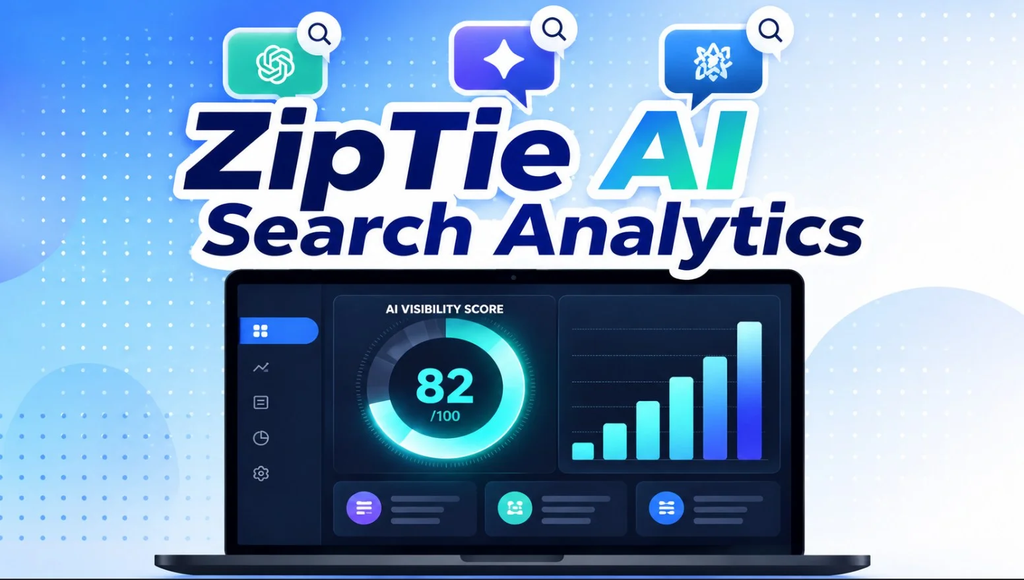
What Is the AI Success Score?
One of ZipTie’s central metrics is its AI Success Score.
According to the platform, the score combines signals including:
- Citation rate
- Brand mention rate
- Sentiment
The resulting score is presented on a 0–100 scale and can be tracked over time.
The purpose is to give businesses a single metric they can use alongside more detailed AI search data.
However, businesses should not treat one AI response as a permanent measurement. AI-generated answers can vary between searches. ZipTie addresses this by collecting repeated measurements and using historical trends rather than relying on one response.
ZipTie vs Traditional SEO Analytics
Traditional SEO and AI search analytics measure different aspects of online visibility.
| Traditional SEO | AI Search Analytics |
| Keyword rankings | AI answer visibility |
| Search impressions | Brand mentions |
| Organic clicks | AI citations |
| Backlinks | AI source usage |
| SERP positions | AI recommendations |
| Search traffic | AI response trends |
This does not mean AI search analytics replaces SEO.
Instead, it can provide another layer of information for businesses that want to understand how their content and brand appear inside generative search experiences.
Key Features of ZipTie AI Search Analytics
AI Search Monitoring
ZipTie monitors selected prompts across supported AI search engines and stores the resulting responses for analysis.
Competitor Tracking
Businesses can compare visibility across tracked prompts and see which competitors show up in AI-generated responses.
Prompt Monitoring
The Prompts & URLs section allows businesses to monitor individual queries and examine their AI Success Scores, citations, mentions, sentiment, and full responses.
LLM Trends
The LLM Trends feature allows users to compare performance across AI engines and examine changes in metrics such as citations, mentions, sentiment, and AI Success Score.
Search Console Integration
ZipTie also provides Google Search Console integration, allowing traditional search information such as clicks, impressions, queries, and pages to be viewed alongside AI search information.
Content Generation
ZipTie offers an optional content-generation module designed to create content intended for AI search visibility. The platform says the feature includes fact-checking and revision capabilities.
API and MCP Access
For teams that want to integrate AI search data into their own workflows, ZipTie provides REST API and Model Context Protocol access as an optional feature.
Who Can Benefit From ZipTie?
ZipTie can be relevant to several types of users.
SEO Professionals
SEO professionals can use AI search monitoring alongside traditional keyword and technical SEO data.
Digital Marketing Agencies
Agencies managing multiple brands can use AI search monitoring to understand how clients appear in generative search results.
SaaS Companies
Software companies can monitor whether AI systems recommend their products when users ask for software comparisons and solutions.
E-Commerce Businesses
E-commerce brands can track whether AI systems mention their products or recommend competitors.
Large Enterprises
Enterprise marketing teams can use historical AI search data to monitor brand visibility across markets and search experiences.
Benefits of AI Search Analytics
AI search analytics can provide several useful insights.
Understand Brand Visibility
Businesses can identify whether AI systems recognize their brand for relevant questions.
Find Citation Opportunities
Tracking citations can reveal which pages are already being used as sources and which queries do not currently produce citations for the business.
Monitor Competitors
Businesses can identify competitors that repeatedly appear in AI-generated recommendations.
Track Changes Over Time
Because AI responses can change, historical measurements can help distinguish temporary fluctuations from longer-term trends.
Connect SEO With AI Search
Integrating traditional search data with AI search information can give marketing teams a broader view of how customers discover information online.
How Businesses Can Use ZipTie More Effectively
Simply tracking AI mentions is not enough. Businesses should turn the data into practical actions.
Focus on Important Customer Prompts
Track questions that closely match your products, services, and target customers.
For example, instead of monitoring only your company name, a business could monitor queries such as:
- Best software for small businesses
- Best accounting services for startups
- Alternatives to [competitor]
- Best tools for [specific industry]
- How to solve [customer problem]
Analyze Competitor Visibility
If competitors consistently appear in relevant AI answers while your business does not, examine the sources and content associated with those answers.
Improve Supporting Content
Businesses can strengthen useful, accurate, well-structured content around the topics they want to be recognized for.
Monitor Trends Rather Than Single Answers
AI responses can vary. A single response should therefore be treated as one observation rather than definitive evidence of long-term visibility.
Repeated measurements provide more useful context.
ZipTie and Generative Engine Optimization
AI search analytics is closely connected with Generative Engine Optimization (GEO), a term used to describe efforts to improve how brands and content appear in AI-generated answers.
Traditional SEO asks:
How can I improve my position in search results?
AI search optimization asks an additional question:
How can I increase the likelihood that AI systems understand, mention, and cite my brand or content?
ZipTie positions its platform around this newer optimization discipline and provides monitoring data that can help businesses evaluate their AI search presence.
Is ZipTie a Replacement for SEO Tools?
No. ZipTie is better understood as an additional analytics layer rather than a complete replacement for traditional SEO platforms.
Traditional SEO remains useful for areas such as:
- Keyword research
- Technical SEO
- Backlink analysis
- Organic rankings
- Search traffic
- Search Console data
- Website performance
AI search analytics addresses a different area: how brands and websites appear inside AI-generated answers.
Using both types of data can help businesses understand traditional search visibility and emerging AI-driven discovery.
The Future of AI Search Analytics
AI search is continuing to develop rapidly.
As users increasingly interact with conversational search systems, businesses will need new ways to measure visibility beyond traditional rankings.
Platforms such as ZipTie reflect this change by focusing on AI-generated answers, citations, mentions, sentiment, competitors, and source analysis.
At the same time, AI search remains dynamic. Different systems can produce different answers to similar prompts, and the same system can change its response over time. For this reason, ongoing monitoring is more informative than relying on a single snapshot.
Final Thoughts
ZipTie AI Search Analytics is designed to help businesses understand how AI search engines represent their brands and websites.
Its platform monitors AI-generated answers across multiple search experiences and provides information about mentions, citations, sentiment, competitors, prompts, and AI Success Scores.
For businesses adapting to AI-driven search in 2026, this type of analytics can provide useful information that traditional keyword-ranking tools do not capture.
The broader lesson is simple: as search evolves from lists of links toward conversational answers, businesses need to monitor not only where they rank, but also whether AI systems recognize, describe, recommend, and cite them.

Post Comment