AI in Project Management Market: Growth, Trends & Future Outlook
Artificial intelligence is rapidly changing how organizations plan, execute, monitor, and deliver projects. From intelligent scheduling and automated reporting to predictive risk management and resource optimization, AI-powered technologies are becoming an increasingly important part of modern AI in Project Management Market.
The AI in Project Management Market is expanding as businesses look for better ways to manage increasingly complex projects, distributed teams, large datasets, and changing customer requirements. AI can help project teams move from reactive management toward more predictive and data-driven project delivery.
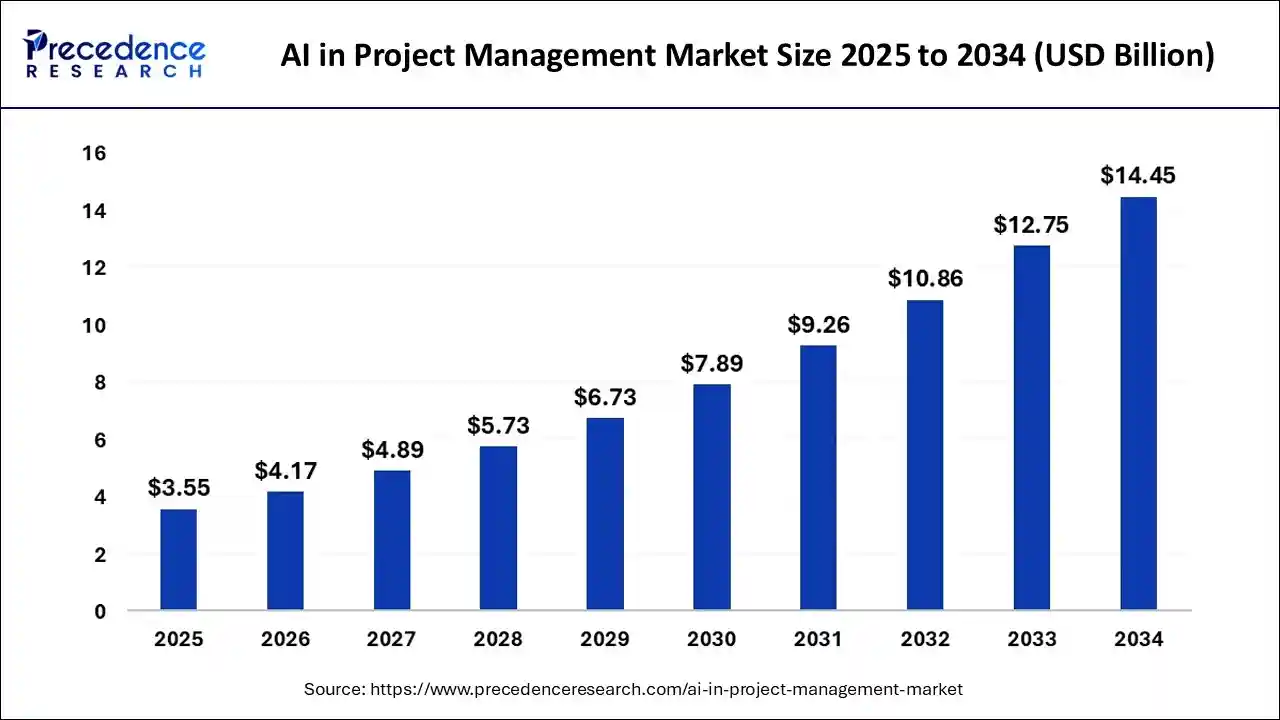
According to Fortune Business Insights, the global AI in project management market was valued at $3.67 billion in 2025 and is projected to reach $13.29 billion by 2034, representing a CAGR of 15.70% from 2026 to 2034. Another 2026 market study from The Business Research Company estimates the market at $4.28 billion in 2026 and forecasts it to reach $8.9 billion by 2030. These differences reflect different methodologies and market definitions, but both point toward substantial growth.
What Is the AI in Project Management Market?
The AI in Project Management Market covers software, platforms, services, and technologies that use artificial intelligence to improve project planning and execution.
AI-powered project management solutions can support activities such as:
- Project planning and scheduling
- Resource allocation
- Budget management
- Risk prediction
- Task prioritization
- Progress monitoring
- Data analysis
- Reporting and visualization
- Workflow automation
- Team collaboration
- Forecasting
- Decision support
These solutions commonly use technologies such as machine learning, natural language processing, predictive analytics, generative AI, and intelligent automation.
Rather than replacing project managers, AI is increasingly being positioned as a tool that helps them make faster and better-informed decisions.
Why Is the AI in Project Management Market Growing?
Several factors are contributing to the expansion of AI-powered project management.
Increasing Project Complexity
Modern projects often involve multiple departments, locations, technologies, vendors, and stakeholders. Managing these interconnected variables manually can become difficult.
AI can analyze project information and identify relationships between tasks, resources, deadlines, and risks.
Demand for Greater Efficiency
Organizations are under constant pressure to deliver projects faster while controlling costs.
AI can automate repetitive activities such as status reporting, task classification, data entry, scheduling assistance, and information retrieval. This allows project professionals to spend more time on strategic activities.
Growth of Remote and Hybrid Teams
Distributed teams have made project visibility more challenging.
AI-powered platforms can collect information from multiple workflows and provide centralized insights into project progress, workloads, deadlines, and potential problems.
The Business Research Company identifies the rise of remote work arrangements as one of the factors supporting market growth.
Key Applications of AI in Project Management
AI is being integrated into several stages of the project lifecycle.
AI-Powered Project Planning
AI can analyze historical project data and help teams develop more realistic schedules.
Instead of relying entirely on manually estimated timelines, AI systems can examine previous project performance, dependencies, resource availability, and workload information to support planning.
Intelligent Scheduling
Scheduling is one of the most important applications of AI in project management.
AI can evaluate multiple variables and recommend task sequences, deadlines, and resource assignments. When project conditions change, intelligent systems may also help teams identify scheduling adjustments.
Resource Allocation
Poor resource allocation can create bottlenecks and increase project costs.
AI can analyze employee workloads, skills, availability, project requirements, and deadlines to help organizations allocate resources more effectively.
Predictive Risk Management
Traditional project management often identifies risks after they become visible.
AI introduces a more predictive approach.
Machine-learning systems can analyze historical and real-time project information to identify patterns associated with delays, budget problems, resource shortages, or other potential risks.
Automated Reporting
Project managers can spend considerable time preparing status reports.
AI can collect information from project-management systems and generate summaries of progress, outstanding tasks, risks, and milestones.
This can reduce administrative workloads while improving project visibility.
Task Automation and Prioritization
AI can help categorize tasks according to urgency, importance, dependencies, and deadlines.
Generative AI can also assist with creating task descriptions, meeting summaries, project documentation, and communication drafts.
Generative AI Is Changing Project Management
Generative AI is becoming an important development within the broader AI in project management market.
Unlike traditional automation, generative AI can create new content based on instructions and available information.
Project teams can use it to:
- Summarize meetings
- Draft project updates
- Create documentation
- Generate project plans
- Explain project data
- Prepare stakeholder communications
- Identify action items
- Create risk summaries
- Answer questions about project information
This makes AI more accessible to project managers and team members who may not have technical expertise.
AI Agents and the Next Stage of Project Management
The next evolution may involve AI agents that can perform multiple connected activities rather than simply responding to individual prompts.
For example, an AI agent could potentially monitor a project’s progress, identify a delay, analyze its potential impact, recommend corrective actions, and prepare an update for the project manager.
This could transform AI from a productivity assistant into an active participant in project workflows.
However, human oversight remains important, particularly when decisions involve budgets, employees, customers, contracts, or significant business risks.
Market Segmentation
The AI in project management market can be analyzed across several dimensions.
By Component
The market generally includes:
- AI-powered software solutions
- Professional and implementation services
Fortune Business Insights expects the solutions segment to account for a large share of the market during the forecast period.
By Deployment
AI project management platforms can be deployed through:
- Cloud-based systems
- On-premises infrastructure
Cloud deployment is particularly attractive to organizations that need scalability, remote access, integrations, and faster implementation.
By Organization Size
AI project management solutions serve:
- Large enterprises
- Small and medium-sized businesses
Large enterprises may have more complex project environments and larger technology budgets, while SMEs can use cloud-based AI tools to access capabilities without building extensive internal infrastructure.
By Application
Major application areas include:
- Project planning
- Scheduling
- Budgeting
- Resource management
- Risk management
- Task automation
- Data analytics
- Reporting
- Project monitoring
- Forecasting
By Industry
AI-powered project management can be applied across industries such as:
- IT and telecommunications
- Banking and financial services
- Healthcare
- Manufacturing
- Construction
- Retail
- Government
- Energy
- Professional services
Regional Outlook
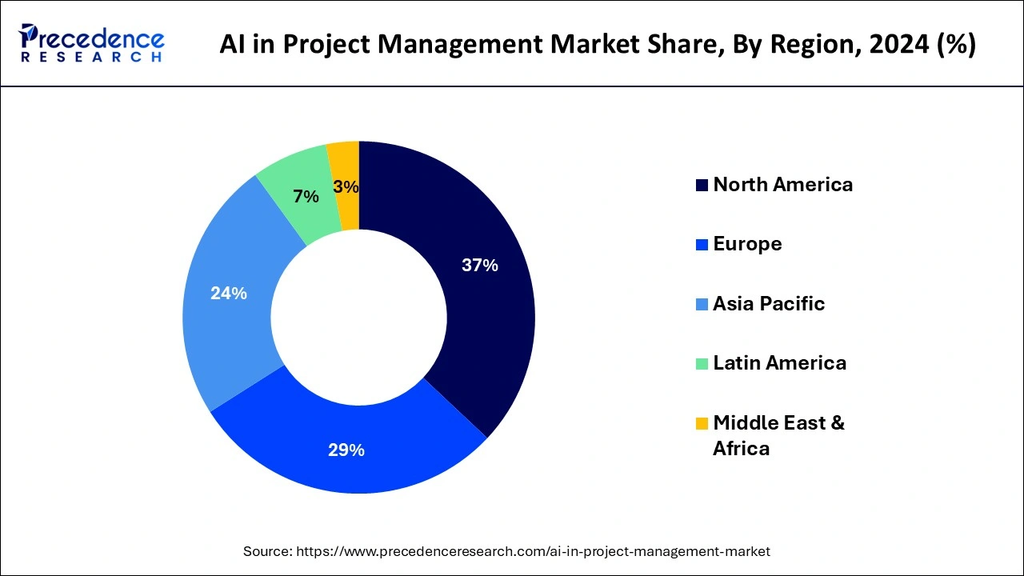
North America currently represents a major market for AI-powered project management.
Fortune Business Insights estimates that North America accounted for 48.1% of global AI in project management market revenue in 2025, with the regional market valued at approximately $1.76 billion. Europe represented 25.9%, while Asia Pacific accounted for 18.9%.
The strong position of North America is associated with advanced digital infrastructure, enterprise AI adoption, technology investment, and the presence of major software companies.
Asia Pacific is also expected to be an important growth region as businesses accelerate digital transformation and adopt cloud and AI technologies.
Benefits of AI in Project Management
Organizations adopting AI-powered project management can potentially achieve several benefits.
Better Decision-Making
AI can process large volumes of project information and provide insights that support more informed decisions.
Improved Resource Utilization
Intelligent resource allocation can help reduce underutilization and identify potential capacity problems.
Faster Project Delivery
Automation and predictive insights can help teams identify bottlenecks earlier and respond more quickly.
Reduced Administrative Work
Automating reporting, documentation, task management, and information processing can free project managers from repetitive activities.
Improved Risk Visibility
Predictive analytics can help teams identify potential problems before they become major project failures.
Greater Project Transparency
AI can consolidate information from different systems and provide a clearer view of project performance.
Challenges Facing the Market
Despite strong growth potential, AI adoption in project management also presents challenges.
Data Quality
AI systems depend heavily on the quality of the data they receive. Incomplete, outdated, or inconsistent project data can reduce the reliability of AI-generated recommendations.
Security and Privacy
Project management platforms may contain confidential business information, employee data, financial information, and customer details.
Organizations therefore need strong security controls and clear data governance policies.
AI Accuracy
AI-generated information should not automatically be treated as correct.
Project managers should validate important recommendations, particularly when AI is being used for financial forecasts, risk assessments, or major operational decisions.
Employee Adoption
Technology adoption can fail when employees do not understand how or why a new system should be used.
Training and change management are therefore important parts of successful implementation.
Integration
Organizations often use multiple project-management, communication, financial, and enterprise systems.
AI solutions need to integrate effectively with existing technology to provide useful insights.
AI Will Not Simply Replace Project Managers
One of the biggest misconceptions about AI in project management is that automation will eliminate the role of the project manager.
In reality, AI is more likely to change the responsibilities of project professionals.
AI can handle information-heavy and repetitive activities, while project managers can focus more heavily on:
- Strategic decision-making
- Stakeholder management
- Leadership
- Negotiation
- Problem-solving
- Team development
- Business alignment
The role may therefore shift from manually managing project information to orchestrating people, technology, data, and business objectives.
Future Trends in the AI in Project Management Market
Several trends are likely to shape the market over the coming years.
Predictive Project Management
Organizations will increasingly use AI to forecast delays, cost overruns, resource shortages, and other potential problems before they occur.
AI-Powered Project Assistants
Conversational AI assistants will become more deeply integrated into project-management platforms, allowing users to ask questions and receive project insights through natural language.
Autonomous AI Workflows
AI agents could eventually manage larger portions of routine project workflows with human approval and supervision.
Real-Time Project Intelligence
Instead of relying only on weekly or monthly reports, organizations will increasingly expect real-time information about project performance.
Deeper Enterprise Integration
AI project-management platforms are likely to connect more closely with CRM, ERP, HR, finance, communication, and collaboration systems.
Greater Focus on Responsible AI
As AI becomes more influential in business decisions, organizations will place greater emphasis on transparency, security, governance, and accountability.
The Future Outlook
The long-term outlook for the AI in Project Management Market is strong.
Fortune Business Insights forecasts growth from $4.14 billion in 2026 to $13.29 billion by 2034, while The Business Research Company forecasts growth from $4.28 billion in 2026 to $8.9 billion by 2030. Other research providers have published different estimates, demonstrating that market projections vary depending on methodology and market scope.
Despite these differences, the underlying trend is consistent: organizations are increasingly investing in AI to improve planning, forecasting, automation, resource management, and decision-making.
The market’s future will likely depend not only on the capabilities of AI technology but also on how effectively organizations integrate these systems into real-world project workflows.
Conclusion
The AI in Project Management Market is moving from an emerging technology segment toward a significant part of the enterprise software landscape.
AI can help organizations automate repetitive work, improve resource allocation, predict risks, enhance reporting, and make better use of project data. Generative AI and AI agents could take this transformation even further by creating more interactive and intelligent project workflows.
However, successful adoption requires more than simply adding AI to existing software. Organizations need reliable data, employee training, strong governance, secure systems, and appropriate human oversight.
The future of project management is therefore unlikely to be completely human or completely automated. Instead, the most successful organizations may be those that combine AI-powered intelligence with human leadership, judgment, and collaboration.



Post Comment