What Are AI Decision-Making Frameworks?
Introduction
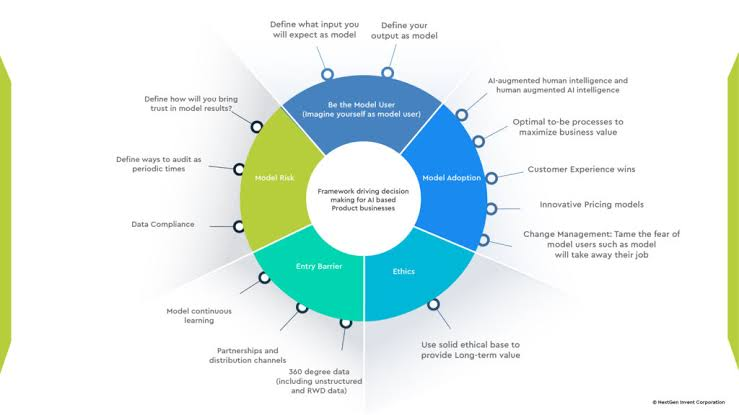
Artificial intelligence (AI) is changing how businesses analyze information, solve problems, and make decisions. From marketing and finance to healthcare and customer service, AI systems help organizations process data, identify patterns, and generate recommendations.
However, accurate AI outputs do not always lead to good decisions. A system may analyze information correctly but overlook important context, ethical concerns, or real-world consequences. This is where AI decision-making frameworks become important.
AI decision-making frameworks provide structured methods for evaluating AI recommendations, managing risks, and combining automated analysis with human judgment. They help organizations make informed, responsible, and effective decisions.
What Are AI Decision-Making Frameworks?
AI decision-making frameworks are structured processes, guidelines, and principles that help organizations use artificial intelligence to make or support decisions.
These frameworks establish how AI systems should be evaluated, how recommendations should be reviewed, and who is responsible for the final outcome. They may also include rules for data quality, fairness, transparency, accountability, and risk management.
For example, a company might use AI to predict which customers are most likely to purchase a product. A decision-making framework helps the company evaluate the reliability of that prediction, consider customer privacy, assess business goals, and decide what action to take.
The purpose is not simply to make decisions faster. It is to make them more reliable, relevant, and responsible.
Why Are AI Decision-Making Frameworks Important?
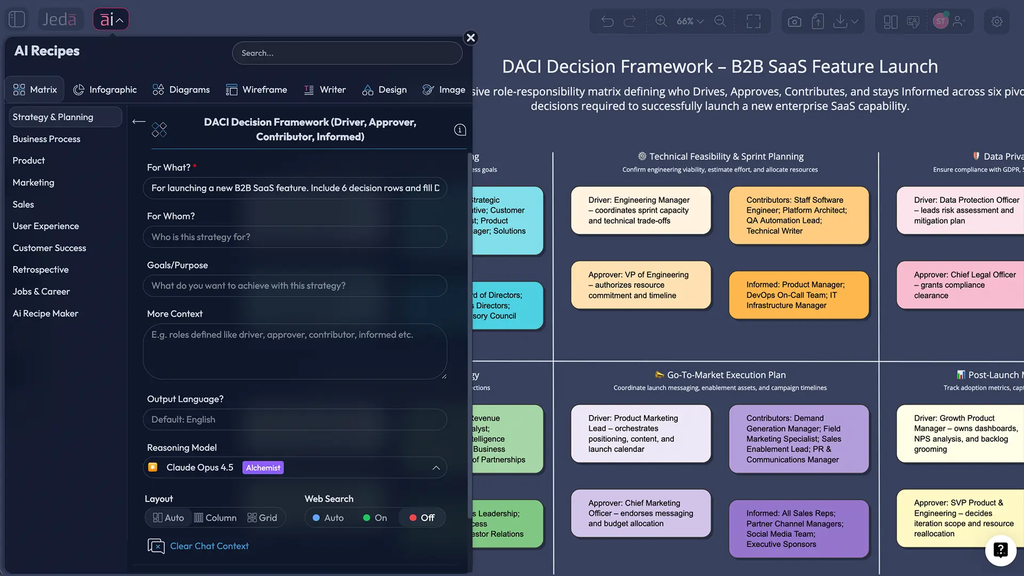
AI decision-making frameworks help organizations use AI more effectively while reducing the risks associated with automated recommendations.
Improved accuracy: Frameworks encourage organizations to evaluate AI outputs and verify whether they are supported by reliable data.
Better risk management: They help identify potential errors, biases, and unintended consequences before decisions are implemented.
Human oversight: They define when people should review, approve, or challenge AI-generated recommendations.
Transparency: They encourage clear documentation of how AI contributes to important decisions.
Accountability: They establish responsibilities for monitoring AI systems and addressing problems.
Types of AI Decision-Making Frameworks
1. AI Risk Management Framework
Risk management frameworks help organizations identify, measure, and manage potential risks associated with AI systems.
Govern, Map, Measure, and Manage are the four main roles of the NIST AI Risk Management Framework. These functions help organizations establish accountability, understand AI use cases, evaluate risks, and take appropriate action.
2. Human-in-the-Loop Framework
Human-in-the-loop frameworks combine AI analysis with human review. AI can generate predictions or recommendations, while a person reviews the results before a decision is finalized.
This approach is particularly useful when decisions involve significant financial, ethical, legal, or personal consequences.
3. Explainable AI Framework
Explainable AI frameworks focus on making AI outputs and behavior more understandable. They can help users investigate recommendations, identify potential problems, and evaluate whether a system is suitable for a particular purpose.
An explanation alone does not guarantee that an AI decision is correct or fair, so testing remains essential.
4. Decision Intelligence Framework
Decision intelligence combines AI, data analytics, business knowledge, and decision theory to improve outcomes.
Rather than focusing only on predictions, this approach examines the available options, possible consequences, business objectives, and evidence needed to make a sound decision.
5. Risk-Based Decision Framework
Risk-based frameworks adjust the level of oversight according to the potential impact of a decision. While high-impact judgements require more thorough testing, monitoring, and human engagement, low-risk tasks might only require minimal oversight.
How Do AI Decision-Making Frameworks Work?
Organizations can implement an AI decision-making framework through a series of practical steps:
- Define the objective: Identify the problem and the outcome the organization wants to achieve.
- Collect reliable data: Ensure that the information used by the AI system is relevant and sufficiently accurate.
- Evaluate AI outputs: Test the system’s performance, limitations, and reliability.
- Assess risks: Identify potential bias, errors, privacy concerns, and unintended consequences.
- Apply human oversight: Determine which decisions require review or approval.
- Monitor outcomes: Track performance and update the process when circumstances change.
Following these steps helps businesses use AI as part of a structured decision process rather than relying on automated recommendations without verification.
AI Decision-Making Frameworks in Business
AI decision-making frameworks can support different business functions.
Marketing: Businesses can analyze customer preferences, segment audiences, and evaluate advertising campaigns while considering privacy and brand reputation.
Finance: Financial institutions can use AI to support fraud detection and risk assessment while maintaining appropriate controls and review procedures.
Healthcare: AI can help analyze medical information, but clinical decisions require suitable validation and professional judgment.
Human resources: Organizations can use AI for administrative support and workforce analysis while carefully evaluating fairness and employment-related risks.
Supply chain management: AI can forecast demand and identify disruptions, while decision frameworks account for costs, supplier constraints, and changing market conditions.
Challenges of AI Decision-Making Frameworks
Despite their benefits, implementing AI decision-making frameworks can present several challenges.
- Data quality: Incomplete or outdated data can lead to misleading results.
- AI bias: Models may reproduce unfair patterns present in their training data.
- Limited transparency: Complex models may be difficult to interpret.
- Overreliance on automation: Users may accept recommendations without sufficient review.
- Changing conditions: AI performance can decline when real-world circumstances differ from those used during development.
- Implementation costs: Effective governance, testing, and monitoring require time, expertise, and resources.
Organizations can address these challenges through appropriate testing, staff training, clear accountability, and continuous evaluation.
Conclusion
AI decision-making frameworks help organizations use artificial intelligence in a structured, responsible, and effective way. They provide guidance for evaluating recommendations, managing risks, maintaining human oversight, and measuring real-world outcomes.
Frameworks such as AI risk management, human-in-the-loop decision-making, explainable AI, and decision intelligence offer different approaches to improving decision quality.
As AI becomes more widely used, organizations must recognize that a technically accurate prediction does not automatically produce the right decision. Combining reliable data, clear objectives, human judgment, and responsible AI practices can help businesses make better-informed decisions.


Post Comment