The Rise of AI Agents in Finance: Everything You Need to Know
Introduction
Artificial intelligence (AI) agents are transforming the financial industry by automating complex tasks, improving decision-making, and enhancing customer experiences. Unlike traditional automation tools, AI agents can analyze large volumes of AI Agents in Finance data, learn from patterns, and perform tasks with minimal human intervention. In 2026, banks, insurance companies, investment firms, and fintech businesses are increasingly adopting AI agents to boost efficiency, reduce costs, and deliver more personalized financial services.
What Are AI Agents in Finance?
AI agents are intelligent software systems that use machine learning, natural language processing (NLP), predictive analytics, and automation to perform financial tasks autonomously. They can monitor transactions, assess risks, detect fraud, generate reports, and assist customers through virtual financial assistants.
These agents continuously learn from new data, allowing them to improve accuracy and adapt to changing market conditions.

Key Benefits of AI Agents in Finance
Financial organizations benefit from AI agents in several ways:
- Faster financial data analysis
- Improved fraud detection and prevention
- Enhanced customer service through AI chatbots
- Better risk assessment and credit evaluation
- Automated compliance monitoring
- Reduced operational costs
- Increased productivity and efficiency
- Real-time market insights
- More accurate financial forecasting
- Personalized financial recommendations
Applications of AI Agents in Finance
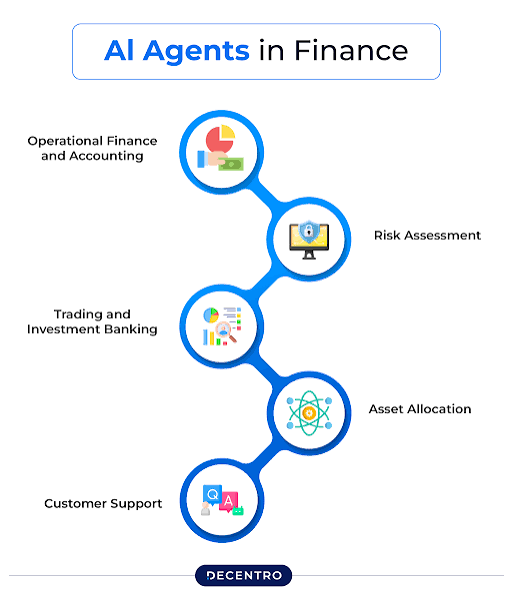
AI agents are being used across multiple areas of the financial sector, including:
Banking
- Customer support automation
- Loan processing
- Account management
- Payment verification
Investment Management
- Portfolio optimization
- Market analysis
- Algorithmic trading
- Investment research
Insurance
- Claims processing
- Fraud detection
- Risk analysis
- Policy recommendations
Financial Compliance
- Regulatory reporting
- Anti-money laundering (AML) monitoring
- Know Your Customer (KYC) verification
- Transaction monitoring
Personal Finance
- Budget planning
- Expense tracking
- Savings recommendations
- Financial coaching
Challenges
Despite their advantages, AI agents also present challenges:
- Data privacy and security concerns
- Algorithmic bias
- Regulatory compliance requirements
- Dependence on high-quality data
- Integration with legacy financial systems
- Need for human oversight in critical financial decisions
Financial institutions must balance innovation with transparency, accountability, and regulatory compliance.
Future Trends
The future of AI agents in finance is expected to include:
- More autonomous financial assistants
- Hyper-personalized banking experiences
- Advanced fraud detection using real-time AI
- AI-powered wealth management
- Greater adoption of generative AI for financial analysis
- Improved predictive analytics for investment decisions
- Increased collaboration between human advisors and AI agents
- Stronger AI governance and responsible AI practices
As AI technology evolves, financial organizations will continue to adopt intelligent agents to improve operational efficiency and deliver more secure, data-driven financial services.
Best Practices for Adoption
Organizations implementing AI agents should:
- Ensure strong data governance and cybersecurity.
- Regularly audit AI systems for fairness and accuracy.
- Maintain human oversight for high-impact decisions.
- Comply with financial regulations and privacy laws.
- Continuously monitor and update AI models.
Conclusion
AI agents are reshaping the financial industry by automating routine processes, strengthening fraud prevention, enhancing customer experiences, and improving decision-making through data-driven insights. While challenges such as privacy, compliance, and transparency remain, responsible implementation can help financial institutions unlock significant value. As AI capabilities continue to advance, AI agents will play an increasingly important role in creating smarter, faster, and more resilient financial services.



Post Comment