On-Device AI News: Everything You Need to Know
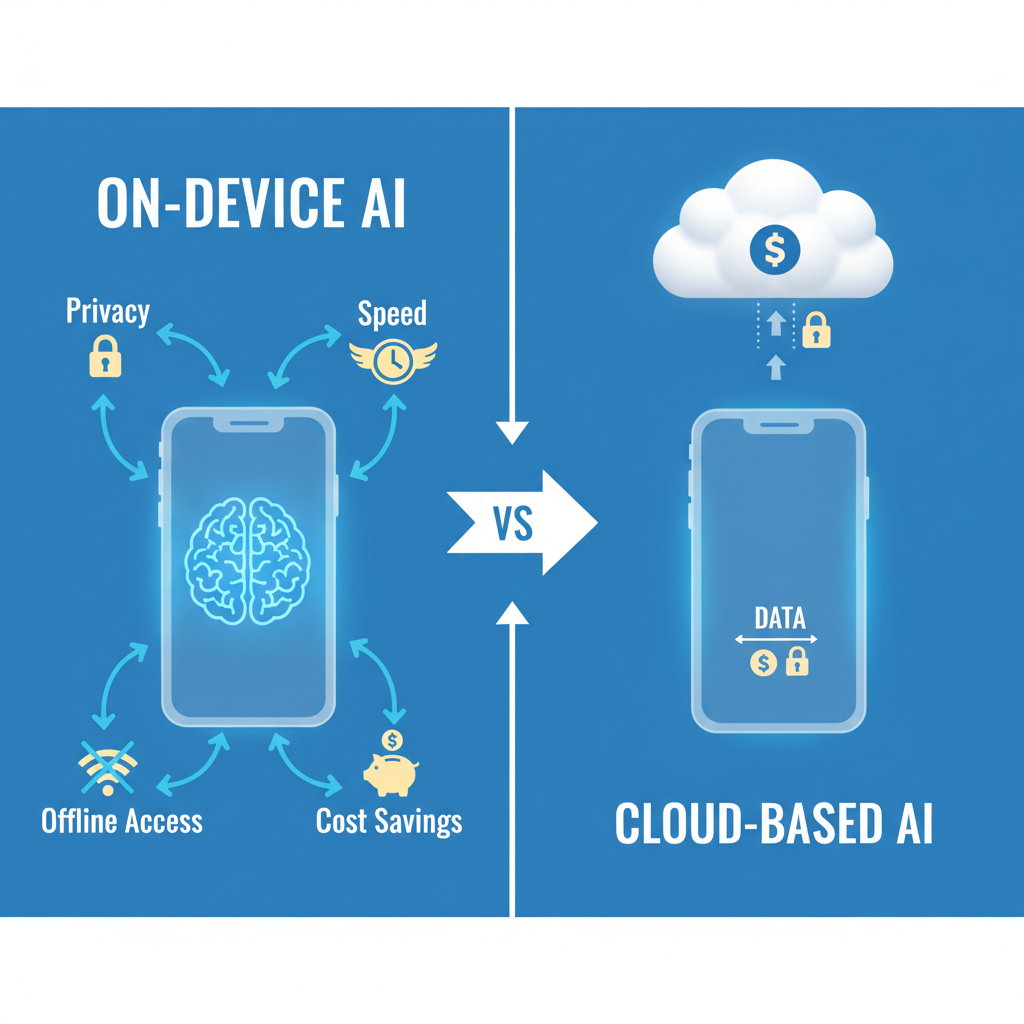
One of the most significant advancements in artificial intelligence is On-Device AI News. On-device AI enables smartphones, computers, automobiles, wearables, cameras, and other connected devices to execute AI tasks locally rather than sending each request to a distant cloud server.
This technology is changing how people interact with AI by offering faster responses, improved privacy, reduced dependence on internet connectivity, and more efficient use of computing resources. As AI continues to move closer to the user, on-device intelligence is expected to play an increasingly important role across consumer technology and business applications.
What Is On-Device AI?
Artificial intelligence models and processing power that run directly on a device instead of only depending on cloud-based data centers are referred to as “on-device AI.”
Information is frequently sent to cloud servers for processing by traditional AI applications. After then, the user’s device receives the outcome. On-device AI changes this approach by performing at least part of the AI processing locally.
For instance, a smartphone with AI capabilities can employ local processing for jobs like:
- Voice recognition
- Image enhancement
- Real-time translation
- Object detection
- Personalized recommendations
- Generative AI features
- Security and authentication
- Text summarization
Modern processors increasingly include dedicated AI hardware, such as neural processing units (NPUs), to handle these workloads efficiently.
Why Is On-Device AI Becoming Important?
The rapid growth of generative AI has increased demand for faster and more efficient AI computing. At the same time, users and businesses are becoming more concerned about privacy, latency, connectivity, and cloud computing costs.
On-device AI addresses several of these challenges.
Faster AI Responses
Certain AI tasks don’t require transit to a distant server and back since processing can take place locally on the device.
Applications may feel more responsive as a result of lower latency. Features such as real-time translation, voice commands, camera intelligence, and AI assistants can benefit from local processing.
Better Privacy
Another important factor driving the expansion of on-device AI is privacy.
For some tasks, sensitive data may not need to leave the device when information is processed locally. This can be particularly useful for personal information, voice recordings, photographs, documents, and other private data.
Local processing does not, however, always ensure total privacy. Developers still need to implement appropriate security, encryption, permissions, and data-handling practices.
Offline AI Capabilities
Cloud-based AI generally requires an internet connection. Even when a device is offline, some tasks can be completed by on-device models.
This can be useful for travelers, remote workers, field employees, emergency situations, and users in areas with unreliable connectivity.
On-Device AI vs Cloud AI
Cloud AI and on-device AI are not necessarily competing technologies. In many modern systems, they work together.
Cloud AI can provide access to large models and significant computing resources, while on-device AI can handle smaller, frequent, or privacy-sensitive tasks.
| Feature | On-Device AI | Cloud AI |
| Processing location | Local device | Remote servers |
| Internet dependency | Often lower | Usually higher |
| Response latency | Potentially lower | Depends on connection |
| Privacy | More local processing possible | Data may be transmitted |
| Computing resources | Limited by device | Large-scale infrastructure |
| Model size | Usually optimized | Can support very large models |
| Offline operation | Possible for supported tasks | Usually limited |
The future of AI may involve hybrid architectures where devices and cloud systems divide workloads based on complexity, privacy, and performance requirements.
On-Device AI in Smartphones
One of the largest markets for on-device AI development is smartphones.
Increasingly potent CPUs with specialised AI acceleration are found in modern smartphones. These capabilities support a wide range of intelligent features.
Examples include:
- AI-powered photography
- Background removal
- Image enhancement
- Voice transcription
- Live translation
- Personalized recommendations
- AI writing tools
- Photo organization
- Face recognition
- Generative AI features
Manufacturers can execute specific AI workloads directly on the phone rather than transmitting all operations to the cloud.
In addition to perhaps lowering the quantity of private data sent to other servers, this can increase responsiveness.
On-Device Generative AI
Generative AI has traditionally relied heavily on powerful cloud infrastructure. Local generative AI is becoming more feasible, nevertheless, thanks to smaller and more effective models.
On-device generative AI can support features such as:
- Text generation
- Summarization
- Writing assistance
- Local document analysis
- Image generation
- Voice processing
- AI-powered search
- Personal assistants
The key challenge is balancing model capability with the limited processing power, memory, storage, and battery capacity of consumer devices.
To make AI models more appropriate for local hardware, developers employ strategies including model quantisation, compression, pruning, and optimised inference.
The Role of NPUs
Neural processing units, commonly known as NPUs, are specialized processors designed to accelerate AI and machine-learning workloads.
Unlike traditional CPUs, NPUs are optimized for the mathematical operations commonly used by neural networks.
Their growing presence in smartphones, laptops, tablets, and other devices is helping manufacturers run more AI workloads locally.
As AI becomes a standard feature of personal computing, dedicated AI hardware is becoming an important part of device design.
On-Device AI in Laptops and PCs
The PC industry is also moving toward AI-enabled computers.
Certain AI workloads can be completed by AI PCs using local processors and NPUs rather than just depending on cloud services.
Potential applications include:
- AI meeting assistance
- Live captions
- Noise reduction
- Video effects
- Document summarization
- Productivity assistants
- Local image processing
- Security monitoring
- Personalized workflows
A new class of computer is emerging as a result of this breakthrough, in which AI features are directly included into operating systems and applications.
On-Device AI in Cars
Automotive technology is another important area for on-device AI.
Vehicles increasingly use AI for driver assistance, cameras, sensors, navigation, voice interaction, and cabin personalization.
Local AI processing can be especially important in vehicles because some applications require extremely fast responses.
For instance, the time it takes to transmit data to a distant server can be decreased by locally analysing camera or sensor data.
As software-defined vehicles become more common, on-device AI could become an important part of automotive computing platforms.
On-Device AI for Wearables
Smartwatches, fitness trackers, earbuds, and other wearable devices can also benefit from local AI.
These devices have limited battery and computing resources, making efficiency particularly important.
On-device AI can support:
- Activity recognition
- Voice commands
- Health and fitness insights
- Noise cancellation
- Personalized recommendations
- Gesture recognition
- Context-aware features
Processing some information locally can also reduce the need to continuously transmit data to cloud services.
Benefits of On-Device AI
The growth of on-device AI is driven by several important benefits.
1. Lower Latency
Local processing can deliver faster responses because information does not always need to travel to a remote server.
2. Improved Privacy
Sensitive information can potentially remain on the device instead of being transmitted to external systems.
3. Offline Functionality
Supported AI features can continue working without a constant internet connection.
4. Reduced Cloud Dependency
Businesses can potentially reduce the amount of AI processing that must be performed in the cloud.
5. Personalized AI
Local models can support more personalized experiences by processing information directly on the user’s device.
6. Better Reliability
Applications that rely on local AI may continue functioning when network connectivity is weak or unavailable.
Challenges of On-Device AI
Despite its advantages, on-device AI also has limitations.
Limited Hardware Resources
Smartphones, wearables, and other edge devices have less processing power, memory, and storage than large cloud data centers.
Battery Consumption
AI workloads can consume significant energy. Developers need to optimize models to maintain performance without rapidly draining batteries.
Model Size
Large AI models can require substantial storage and memory. Smaller optimized models are often necessary for local deployment.
Security Risks
Keeping AI models on a device creates new security considerations. Developers need to protect models, user data, and local processing environments.
Updating AI Models
Cloud systems can update models centrally. Updating models across millions of individual devices can be more complicated.
On-Device AI and Edge AI
On-device AI is closely related to edge AI, but the terms are not always identical.
On-device AI generally refers to AI processing directly on a personal or embedded device.
Edge AI is a broader concept that involves processing data closer to where it is generated. This can include smartphones, cameras, industrial machines, vehicles, gateways, and other edge computing systems.
In simple terms, on-device AI can be considered one important part of the broader edge AI ecosystem.
How Businesses Can Use On-Device AI
Businesses are increasingly exploring local AI for applications where speed, privacy, reliability, or connectivity matters.
Potential use cases include:
- Retail analytics
- Manufacturing systems
- Smart security cameras
- Healthcare devices
- Logistics
- Automotive technology
- Customer service devices
- Industrial monitoring
- Field-service applications
- Enterprise laptops
For example, a manufacturing device could analyze sensor information locally and identify unusual patterns without sending every piece of raw data to the cloud.
The Future of On-Device AI
The future of on-device AI is closely connected to improvements in AI chips, smaller models, software optimization, and energy efficiency.
As processors become more capable, more AI functions can move from cloud infrastructure to local hardware.
Future devices may increasingly combine:
Device AI + Edge Computing + Cloud AI
Simple and privacy-sensitive tasks could be handled locally, more complex workloads could be processed at the edge, and highly demanding AI operations could be sent to cloud infrastructure.
This hybrid model can provide a balance between performance, cost, privacy, and scalability.
What to Watch in On-Device AI News
As the technology develops, several areas are worth watching:
- New AI processors and NPUs
- Smaller generative AI models
- AI smartphones and PCs
- Local AI assistants
- Privacy-focused AI applications
- AI-powered wearables
- Automotive AI systems
- Edge AI deployments
- AI model optimization
- Energy-efficient AI hardware
These developments will help determine how quickly AI moves from centralized cloud platforms into everyday devices.
Final Thoughts
On-Device AI News is changing the way artificial intelligence is delivered. By bringing AI processing closer to users, devices can offer faster responses, greater offline capabilities, and potentially stronger privacy for supported workloads.
From smartphones and laptops to vehicles, wearables, and industrial systems, local AI is becoming an important part of modern technology.
As AI models become smaller and hardware becomes more powerful, on-device AI is likely to become increasingly common. The next generation of intelligent devices will not simply connect to AI services—they will increasingly have AI capabilities built directly into the device itself.




Post Comment