Generative AI in Data Analytics: Everything You Need to Know in 2026

Introduction
Generative AI is transforming data analytics by making it easier for organizations to analyze complex datasets, generate insights, and make data-driven decisions faster than ever before. Instead of relying solely on traditional dashboards and manual analysis, businesses can now use AI to summarize reports, identify trends, create visualizations, and even answer analytical questions using natural language.
In 2026, generative AI has become an essential tool for AI in Data Analytics, business intelligence teams, financial professionals, marketers, healthcare organizations, and enterprises seeking to unlock greater value from their data. By combining advanced machine learning, natural language processing (NLP), and large language models (LLMs), generative AI is helping organizations improve productivity, accuracy, and strategic decision-making.
What Is Generative AI in Data Analytics?
Generative AI in data analytics refers to the use of AI models that can understand, analyze, summarize, and generate insights from structured and unstructured data. Rather than simply displaying data, these systems can interpret information, answer questions, generate reports, and recommend actions.
Generative AI can work with:
- Spreadsheets
- Databases
- Business intelligence dashboards
- Customer data
- Financial records
- Sales reports
- Marketing analytics
- Operational data
- IoT sensor data
The goal is to help users understand data more quickly without requiring advanced technical expertise.
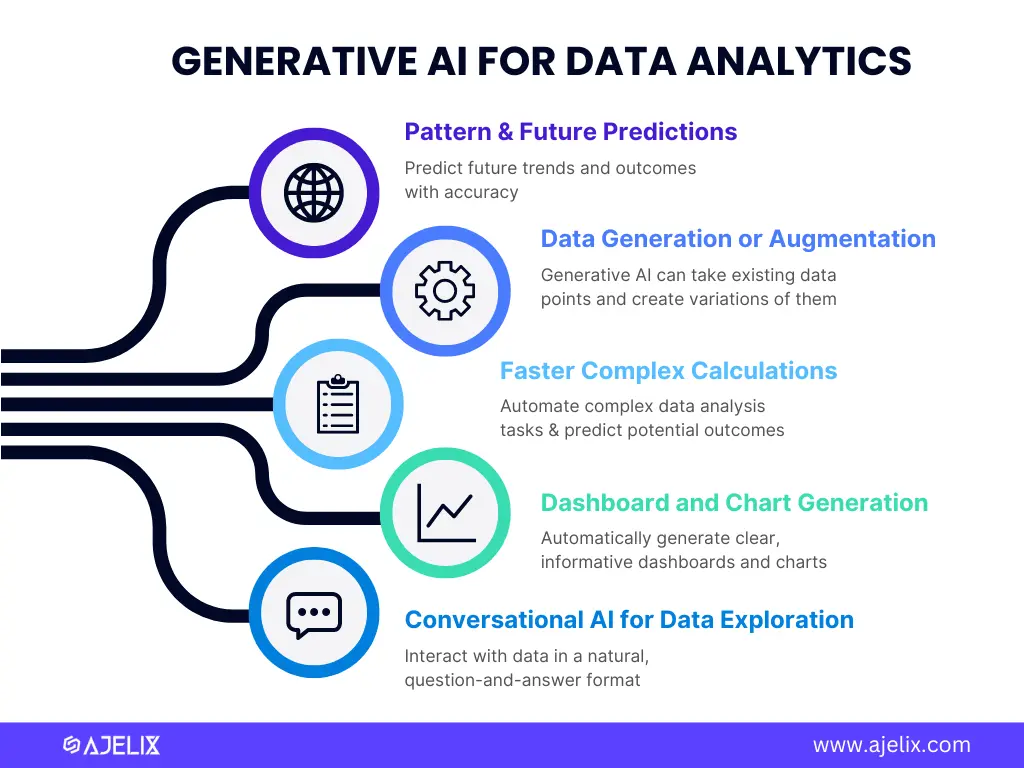
How Generative AI Works in Data Analytics
Generative AI combines several technologies to support analytics workflows.
Natural Language Processing (NLP)
NLP enables users to interact with data using everyday language.
For example:
“What were our highest-selling products last quarter?”
The AI interprets the question, queries the data, and provides a clear answer.
Machine Learning
Machine learning algorithms identify patterns, relationships, and anomalies within datasets, enabling predictive insights and trend analysis.
Large Language Models (LLMs)
LLMs generate summaries, explanations, reports, and recommendations based on analytical results, making complex information easier to understand.
Data Visualization Assistance
AI can automatically recommend or create charts, graphs, and dashboards that best represent the underlying data.
Key Benefits of Generative AI in Data Analytics
Faster Data Analysis
AI reduces the time needed to analyze large datasets, allowing businesses to respond more quickly to changing conditions.
Improved Decision-Making
Organizations gain timely insights that support strategic planning and operational improvements.
Automated Report Generation
Generative AI can create business reports, executive summaries, and performance dashboards with minimal manual effort.
Natural Language Queries
Users without technical expertise can ask questions in plain language instead of writing SQL queries or complex formulas.
Better Forecasting
AI analyzes historical data to predict future trends, customer demand, and business performance.
Enhanced Productivity
Analysts spend less time preparing reports and more time solving business problems.
Common Business Applications
Business Intelligence
Organizations use generative AI to:
- Summarize dashboards
- Explain performance metrics
- Generate executive reports
- Identify key trends
Marketing Analytics
Marketing teams analyze:
- Customer behavior
- Campaign performance
- Website traffic
- Conversion rates
- Audience segmentation
Financial Analytics
Finance departments use AI for:
- Revenue forecasting
- Budget planning
- Risk analysis
- Fraud detection
- Expense monitoring
Sales Analytics
Sales teams benefit from:
- Pipeline analysis
- Customer insights
- Sales forecasting
- Opportunity identification
- Performance tracking
Healthcare Analytics
Healthcare organizations use AI to analyze:
- Patient outcomes
- Operational efficiency
- Medical research
- Resource utilization
- Population health trends
Supply Chain Analytics
Businesses optimize:
- Inventory management
- Demand forecasting
- Logistics planning
- Supplier performance
- Warehouse operations
Popular Features
Modern generative AI analytics platforms often include:
- AI-powered dashboards
- Automated report writing
- Predictive analytics
- Data summarization
- Conversational analytics
- Smart visualizations
- Anomaly detection
- Recommendation engines
- Workflow automation
Challenges
Despite its advantages, generative AI also presents challenges:
Data Quality
Poor-quality data can produce inaccurate insights.
Privacy and Security
Organizations must protect sensitive business and customer information.
AI Hallucinations
Generative AI may occasionally generate incorrect conclusions if data is incomplete or ambiguous.
Regulatory Compliance
Businesses must comply with data protection and industry-specific regulations.
Human Oversight
Critical business decisions should always include human review and validation.
Best Practices
Organizations should:
- Use high-quality, well-governed data
- Validate AI-generated insights
- Protect sensitive information
- Train employees on AI tools
- Monitor AI performance regularly
- Integrate AI with existing analytics platforms
- Establish clear AI governance policies
Future Trends in 2026
Generative AI in data analytics is expected to evolve with:
- Autonomous AI analytics agents
- Real-time decision intelligence
- Multimodal analytics combining text, images, audio, and video
- AI-powered business intelligence platforms
- Advanced predictive and prescriptive analytics
- Personalized analytics assistants
- Greater automation of enterprise reporting
Conclusion
Generative AI is redefining data analytics by enabling faster analysis, automated reporting, predictive insights, and natural language interaction with data. As organizations continue to generate larger volumes of information, AI-powered analytics will play a central role in helping businesses make smarter, faster, and more informed decisions.
In 2026, companies that successfully integrate generative AI into their data analytics strategies will gain a competitive advantage through improved efficiency, stronger decision-making, and deeper business insights.



Post Comment