AI Orchestration: How AI Systems Work Together in 2026
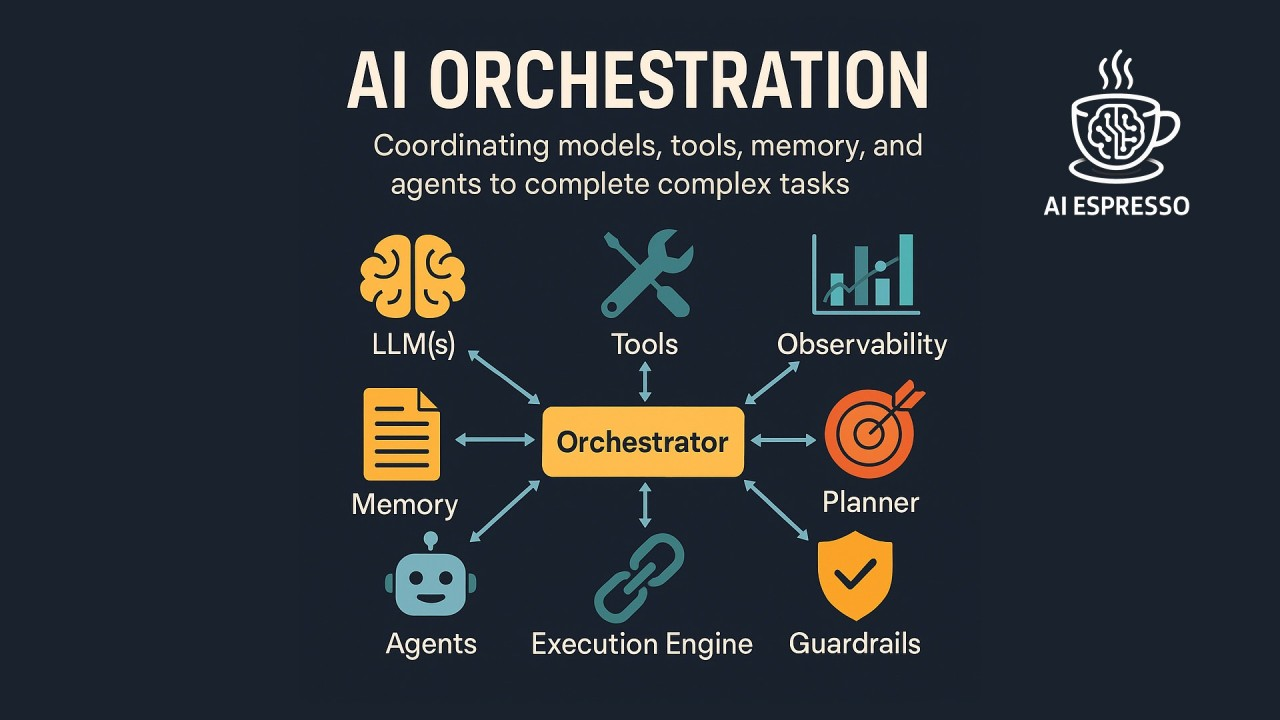
AI Orchestration is moving beyond individual tools and standalone models. In 2026, businesses are increasingly using multiple AI models, agents, applications, and automation systems to complete complex tasks.
However, getting different AI systems to work together efficiently can be challenging. Each system may have different capabilities, data requirements, instructions, and outputs.
This is where AI orchestration becomes important.
AI orchestration provides a structured way to coordinate multiple AI models, agents, tools, data sources, and workflows. Instead of relying on one AI system to handle an entire process, orchestration can divide a task into smaller steps and direct each step to the appropriate system.
What Is AI Orchestration?
AI orchestration is the process of coordinating multiple AI models, agents, tools, data sources, and software systems so they can work together as part of a larger workflow.
A simple AI application might receive a request and generate an answer. An orchestrated AI workflow can involve several stages:
- Understand the user’s request.
- Determine what tasks need to be completed.
- Select the appropriate AI agent or model.
- Retrieve relevant information.
- Perform analysis or calculations.
- Send the result to another system.
- Review or validate the output.
- Deliver the final response.
The orchestration layer manages these interactions and determines how information moves between different components.
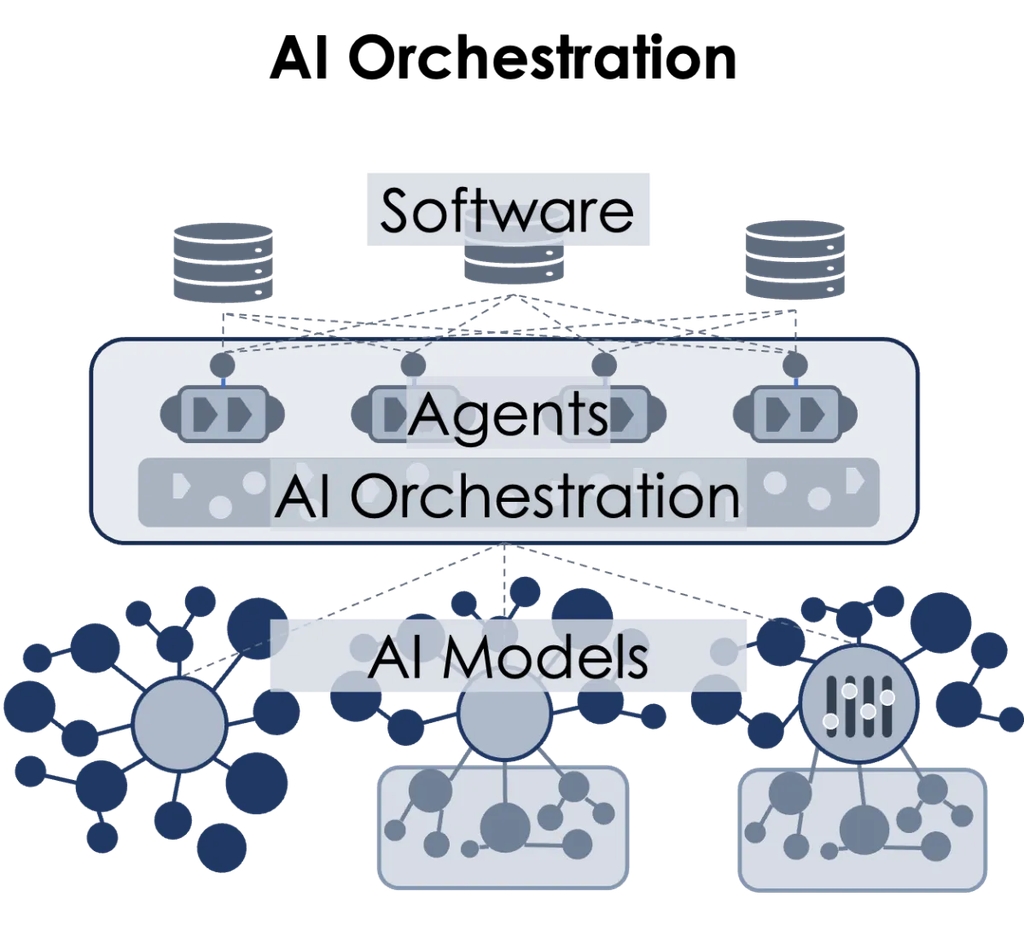
How Does AI Orchestration Work?
AI orchestration typically involves several interconnected components.
1. User Input
The process begins with a request, instruction, event, or business requirement.
For example, a company might ask an AI system to analyze customer feedback and prepare a summary for management.
2. Task Planning
An orchestration system can break the larger objective into smaller tasks.
For example:
- Collect customer feedback
- Categorize comments
- Identify common complaints
- Analyze sentiment
- Summarize findings
- Generate a management report
Breaking a complex workflow into individual steps makes it easier to assign each task to the appropriate tool or AI agent.
3. AI Agent Selection
Different AI systems can be better suited to different tasks.
One agent might specialize in research, another in data analysis, and another in content generation.
The orchestration layer coordinates these systems instead of requiring one model to perform every operation.
4. Tool and Data Access
AI agents often need access to external information.
Depending on the workflow, an orchestrated system may connect AI agents with:
- Databases
- APIs
- Business applications
- Search systems
- Cloud services
- Internal documents
- Analytics platforms
The orchestration layer helps control when and how these resources are accessed.
5. Output Coordination
The results produced by one component may become the input for another.
For example, a research agent could collect information, a data-analysis agent could evaluate it, and a writing agent could turn the findings into a report.
The orchestration system manages this sequence.
AI Orchestration vs. AI Automation
AI orchestration and AI automation are related but different concepts.
AI automation focuses on using AI to perform tasks with limited manual intervention.
AI orchestration focuses on coordinating multiple AI systems, tools, agents, and processes to complete a larger workflow.
For example, automatically generating an invoice summary could be AI automation.
A workflow that collects customer information, checks an internal database, analyzes account history, generates an invoice recommendation, sends the result to an approval system, and records the outcome involves AI orchestration.
In practice, the two technologies can work together.
What Are AI Agents?
AI agents are an important part of modern AI orchestration.
An AI agent is a software system designed to perform tasks using AI capabilities, tools, data, and instructions.
Different agents can have different responsibilities.
For example:
- Research agent: Finds and organizes information.
- Data agent: Analyzes structured data.
- Customer service agent: Handles routine customer requests.
- Coding agent: Assists with software development.
- Planning agent: Creates task sequences.
- Reporting agent: Produces summaries and reports.
AI orchestration can coordinate these agents as part of a larger workflow.
Multi-Agent AI Systems
A multi-agent AI system involves multiple AI agents working together.
Rather than asking a single AI model to perform every task, businesses can create specialized agents with different responsibilities.
Consider an e-commerce business that wants to analyze a product’s performance.
A multi-agent workflow could include:
- A data agent retrieves sales information.
- A research agent gathers market information.
- An analysis agent compares performance.
- A forecasting agent evaluates potential trends.
- A reporting agent creates a final report.
The orchestration layer coordinates the entire process.
Why AI Orchestration Matters in 2026
AI applications are becoming increasingly complex. Businesses may use multiple models, AI agents, enterprise applications, and data sources at the same time.
AI orchestration can help organizations manage this complexity.
Better Workflow Coordination
Instead of managing individual AI tools separately, businesses can connect them through coordinated workflows.
Specialized AI Systems
Different models or agents can be assigned to tasks that match their capabilities.
Greater Scalability
An orchestrated architecture can allow organizations to expand AI workflows without redesigning every process from scratch.
Improved Process Visibility
A well-designed orchestration system can provide information about which tasks were completed, which systems were used, and where failures occurred.
More Flexible AI Infrastructure
Businesses can potentially connect different models and tools rather than relying entirely on a single AI provider or system.
Business Use Cases for AI Orchestration
AI orchestration can be applied to many business processes.
Customer Service
An AI workflow could identify a customer’s request, retrieve account information, classify the issue, create a response, and send complex cases to a human employee.
Marketing
Marketing teams could coordinate AI systems for market research, audience analysis, content creation, campaign planning, and performance analysis.
Finance
AI orchestration can connect document processing, financial analysis, reporting, and approval workflows.
Software Development
Development teams can coordinate AI agents for code generation, testing, debugging, documentation, and code review.
Human Resources
HR workflows could use multiple AI capabilities for candidate screening, interview scheduling, document processing, and employee onboarding.
IT Operations
AI agents can assist with monitoring, incident classification, troubleshooting, and ticket management.
Key Benefits of AI Orchestration
1. Combines Multiple AI Capabilities
Businesses do not have to depend on one model for every task.
2. Supports Complex Workflows
Orchestration can connect multiple steps into a single business process.
3. Enables Specialized Agents
Each AI component can focus on a particular responsibility.
4. Improves Resource Management
Organizations can select different models and tools based on cost, speed, accuracy, or task requirements.
5. Supports Human Oversight
Important workflows can include human approval steps before an action is completed.
Challenges of AI Orchestration
Although AI orchestration offers significant opportunities, it also introduces new challenges.
System Complexity
Connecting multiple AI systems can make an architecture more complicated than a single-model application.
Data Security
AI workflows may involve sensitive business information. Organizations need appropriate access controls and security practices.
Reliability
If one component fails, the entire workflow may be affected. Systems therefore need error handling and recovery mechanisms.
Cost Management
Running several AI models and services can increase operational costs. Businesses need to monitor usage carefully.
Output Quality
AI-generated outputs may contain errors. Validation and human review can be important for high-impact workflows.
Governance
Organizations need clear policies covering data access, model usage, monitoring, accountability, and compliance.
Best Practices for Implementing AI Orchestration
Businesses should approach AI orchestration strategically.
Start With a Clear Business Problem
Do not introduce orchestration simply because multiple AI tools are available.
Identify a real workflow that could benefit from coordinated AI capabilities.
Keep Workflows Modular
Separate different responsibilities into manageable components. This makes systems easier to test and update.
Define Clear Agent Responsibilities
Each agent should have a specific role and clearly defined inputs and outputs.
Monitor Every Step
Businesses should track workflow performance rather than looking only at the final result.
Add Validation
Important outputs should be checked before they trigger consequential actions.
Maintain Human Oversight
Human review can be included at critical decision points, especially when workflows involve financial, legal, customer, or operational consequences.
Plan for Failure
AI workflows should have fallback procedures when an API, model, data source, or agent becomes unavailable.
AI Orchestration and Enterprise AI
Large organizations often have many systems operating across different departments.
An enterprise may have separate platforms for:
- Customer relationship management
- Finance
- Human resources
- Marketing
- Sales
- IT
- Data analytics
AI orchestration can connect AI capabilities with these systems and create workflows that cross departmental boundaries.
For example, a sales workflow could combine customer relationship data, market research, lead analysis, email generation, and sales forecasting.
Instead of treating each AI application as an isolated tool, orchestration creates a connected workflow.
The Role of APIs in AI Orchestration
APIs are an important technical component of AI orchestration.
They allow different applications and services to communicate with one another.
An orchestrated workflow might use APIs to:
- Send information to an AI model
- Retrieve customer information
- Query a database
- Trigger an automation
- Send a notification
- Store a generated result
This allows businesses to build AI workflows that interact with existing technology infrastructure.
AI Orchestration and the Future of Work
AI orchestration could change how employees interact with technology.
Instead of manually switching between several applications, employees may increasingly interact with an AI-powered workflow that coordinates different systems behind the scenes.
For example, an employee could ask an AI assistant to prepare a customer report. The orchestration layer could retrieve customer data, analyze recent interactions, summarize relevant documents, generate the report, and present it for human review.
This does not necessarily eliminate the employee’s role. Instead, it can shift the employee’s focus from performing individual administrative tasks toward reviewing results and making decisions.
What Is the Future of AI Orchestration?
As AI systems become more capable, orchestration is likely to become an important part of AI infrastructure.
Future AI workflows may involve increasingly specialized agents working together across business applications. Organizations will also need better monitoring, governance, security, and evaluation systems to manage these workflows responsibly.
The goal will not simply be to connect as many AI systems as possible. Effective orchestration will depend on choosing the right models, tools, agents, data sources, and human checkpoints for each workflow.
Final Thoughts
AI orchestration provides a way to coordinate AI models, agents, tools, data sources, and business applications within a unified workflow.
In 2026, businesses are moving beyond the idea of using one AI model for every problem. Instead, organizations can combine specialized AI capabilities and coordinate them through structured workflows.
The most effective implementations will focus on clear business objectives, modular architecture, reliable data, security, monitoring, validation, and appropriate human oversight.
As AI continues to evolve, the ability to make different AI systems work together efficiently may become just as important as the capabilities of individual AI models.

Post Comment