Keyword Search vs Semantic Search: Which Search Method Is Better?
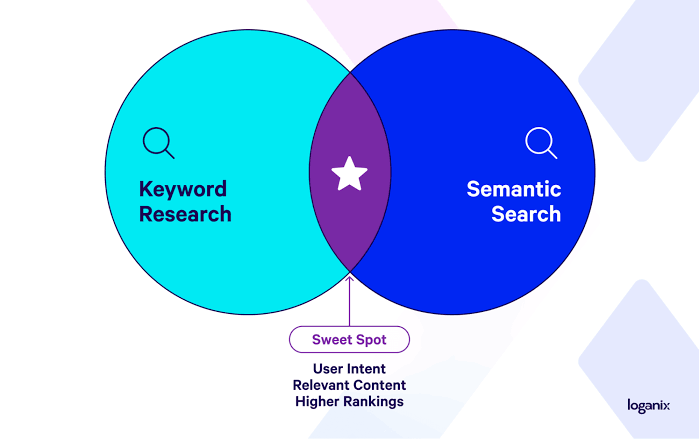
The advancement of artificial intelligence has had a substantial impact on search technologies. Traditional keyword search depends mainly on matching the words entered by a user with words found in documents, webpages, or databases. Semantic search takes a different approach by attempting to understand the meaning, context, and intent behind a query. Understanding keyword search vs semantic search is important for businesses, marketers, website owners, and developers who want to improve how users discover information online.
What Is Keyword Search?
Keyword search is a traditional search method that focuses on the specific words or phrases included in a query.
For example, if someone searches for:
“best smartphones under $500”
a keyword-based system may look for webpages containing terms such as “best,” “smartphones,” and “$500.”
Traditional keyword search can be effective when the user’s query closely matches the wording contained in the available content. It is also relatively straightforward to implement and can work efficiently with structured databases and large collections of documents.
However, keyword matching can struggle when users use different words to express the same idea.
What Is Semantic Search?
Semantic search uses technology designed to understand the meaning and context of a search query rather than relying only on exact keyword matches.
For example, a user might search:
“phones that take great pictures at night”
A semantic search system may understand that the user is looking for smartphones with strong low-light photography capabilities, even if those exact words do not appear together on a webpage.
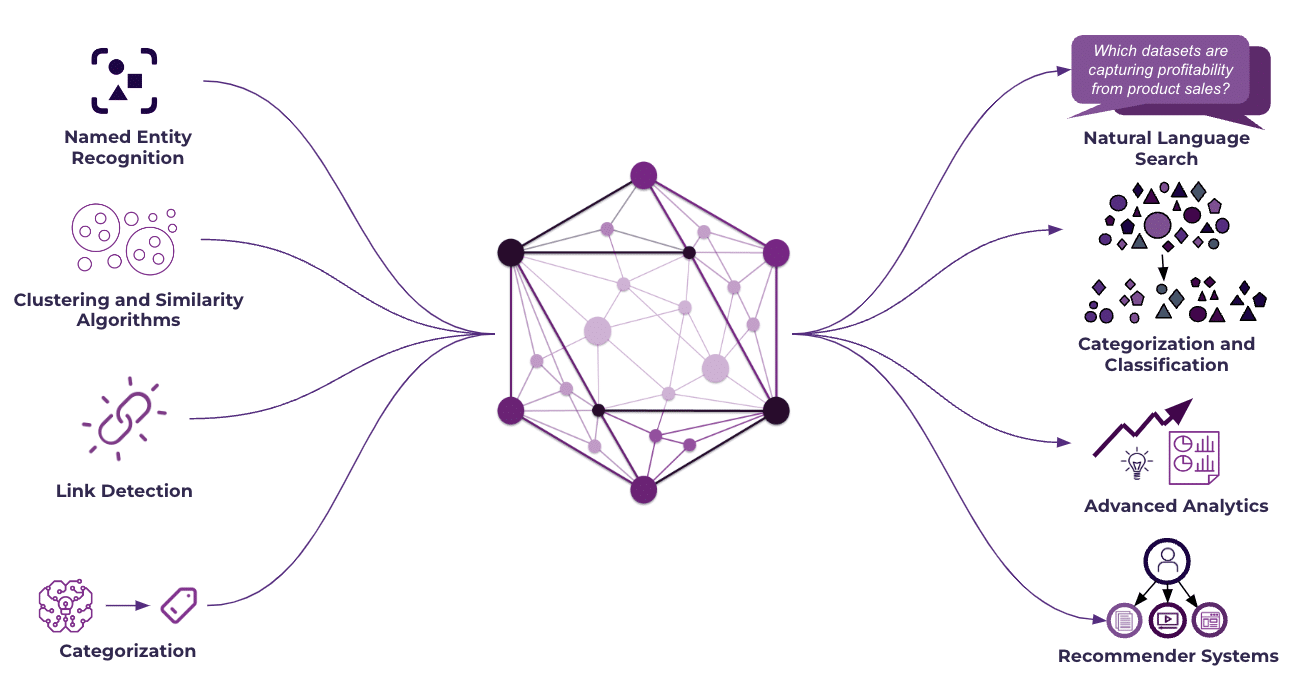
Modern semantic search commonly uses artificial intelligence, natural language processing, machine learning, and vector-based representations to identify relationships between words, concepts, and queries.
Keyword Search vs Semantic Search
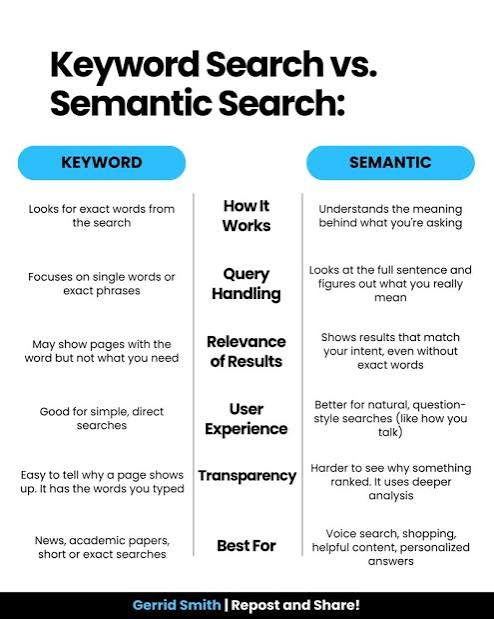
The main difference between keyword search and semantic search is how they interpret information.
| Feature | Keyword Search | Semantic Search |
| Primary focus | Exact words and phrases | Meaning and intent |
| Context understanding | Limited | Stronger |
| Natural-language queries | Can be challenging | Better suited |
| Synonyms | Often limited | Can recognize related concepts |
| AI involvement | Not always required | Commonly uses AI |
| Search intent | Limited understanding | More context-aware |
| Traditional databases | Highly suitable | Can require additional technology |
“Which documents contain these words?” is the main question posed by keyword search.
Semantic search attempts to answer, “Which information is most relevant to what the user means?”
How Keyword Search Works
A traditional keyword search system generally processes a query by identifying important terms and comparing them against an index.
The system may consider factors such as:
- Keyword frequency
- Exact phrase matches
- Document relevance
- Metadata
- Search indexes
- Word proximity
Search engines and internal website search systems can use sophisticated ranking techniques while still relying heavily on textual signals.
For clearly defined searches, this approach can be fast and effective.
How Semantic Search Works
Text is usually represented via semantic search as data that may be compared according to relationships and meaning.
AI models are capable of analysing a query and producing a meaning representation. Similar representations can also be used for documents or passages. The system can then identify information that is conceptually related to the query.
For example, consider these two searches:
“How can I reduce my electricity bill?”
and
“Ways to lower household energy costs”
The basic meaning is similar even though the terminology is different. Semantic search can recognize this relationship more effectively than a system that depends primarily on exact keyword matching.
Advantages of Keyword Search
Keyword search remains useful for many applications.
1. Simple Queries
When users know exactly what they are looking for, keyword search can provide highly relevant results.
2. Fast Retrieval
Well-designed indexes can process keyword queries extremely quickly, even across large databases.
3. Predictable Results
Because the system focuses on specific terms, developers can have greater control over matching behavior.
4. Useful for Structured Data
Keyword search can work particularly well for product catalogs, databases, document repositories, and other structured information systems.
Limitations of Keyword Search
Keyword-based systems can have difficulty understanding language variations.
For example, someone searching for “cheap running shoes” may receive different results from someone searching for “affordable sneakers for jogging,” even though the underlying intent is similar.
Other limitations can include:
- Difficulty understanding synonyms
- Limited context awareness
- Challenges with conversational queries
- Dependence on specific wording
- Difficulty interpreting ambiguous language
These limitations become more noticeable as users expect search systems to understand natural language.
Advantages of Semantic Search
Semantic search provides several benefits for modern AI-powered applications.
1. Better Understanding of Intent
Semantic systems can analyze the meaning behind a query rather than focusing exclusively on individual words.
2. Natural-Language Interaction
Users can ask questions in conversational language without needing to identify the exact keywords used by a database.
3. Context Awareness
Semantic search can consider relationships between concepts and terms.
4. More Relevant Discovery
Because the system can identify conceptual similarities, it may retrieve information that does not contain an exact keyword match.
Limitations of Semantic Search
Semantic search also has challenges.
AI-based semantic systems can require more computational resources than basic keyword search. Building and maintaining these systems may also require specialized infrastructure, models, embeddings, vector databases, and ranking techniques.
Another challenge is relevance. Understanding meaning does not automatically guarantee that every retrieved result will be useful. Search systems still need effective ranking, filtering, and evaluation methods.
Semantic Search and AI
Semantic search has advanced more quickly thanks to artificial intelligence.
Natural language processing allows AI systems to analyze relationships between words and concepts. Embedding models can transform text into numerical representations that capture semantic relationships.
Vector databases can then store and search these representations efficiently.
This technology is increasingly used in:
- AI assistants
- Enterprise search
- E-commerce
- Customer support
- Knowledge bases
- Recommendation systems
- Document management
- Content discovery
Which Search Method Is Better?
There is no universal answer because the better method depends on the application.
Keyword search can be appropriate when exact terms, predictable matching, and structured data are important.
Semantic search can be more useful when users ask natural-language questions or when the system needs to understand concepts, context, and search intent.
Many modern search platforms combine both approaches. This is known as hybrid search.
What Is Hybrid Search?
Hybrid search combines keyword-based retrieval with semantic search.
For example, a system can use traditional keyword matching to identify documents containing important terms while simultaneously using semantic similarity to discover conceptually related content.
The two sets of results can then be combined and ranked.
This approach can provide the precision of keyword search while adding some of the contextual understanding associated with semantic search.
Keyword Search vs Semantic Search for SEO
The difference is also important for search engine optimization.
Traditional SEO has often focused on specific keywords and phrases. However, modern search systems increasingly consider topics, context, entities, user intent, and relationships between concepts.
This means content creators should not rely only on repeating a target keyword. High-quality content should answer the user’s question comprehensively and use natural language.
Instead of creating separate pages for every slight variation of a keyword, publishers can build useful content around a broader topic and address related questions naturally.
The Future of Search
Search is moving toward increasingly intelligent and conversational experiences.
AI-powered systems can process longer questions, understand context, connect related concepts, and provide information in more natural formats.
However, traditional keyword search is unlikely to disappear completely. Exact matching remains valuable for many use cases, particularly when users need specific product names, document identifiers, codes, or technical terms.
The future of search will likely involve multiple retrieval methods working together rather than one method replacing everything else.
Conclusion
The debate over keyword search vs semantic search is ultimately about how information should be retrieved.
Keyword search focuses primarily on words and phrases, while semantic search focuses more heavily on meaning, context, and intent. Keyword search remains useful for precise and structured queries, whereas semantic search can provide advantages when users express complex ideas in natural language.
For many modern applications, hybrid search offers a practical approach by combining keyword matching with semantic understanding.
As AI continues to improve, search systems are likely to become better at understanding not only what users type, but also what they actually mean.


Post Comment