Vulnerability Management: How to Reduce Cybersecurity Risk
As cyber threats continue to evolve, businesses need effective ways to identify and address security weaknesses before attackers can exploit them. Vulnerability Management is an important cybersecurity process that helps organizations discover vulnerabilities, assess their potential impact, and take action to reduce security risks.
Rather than waiting for a cyberattack to happen, businesses can use vulnerability management to take a proactive approach to protecting their systems, applications, networks, and sensitive data.
What Is Vulnerability Management?
Vulnerability Management is the continuous process of identifying, evaluating, prioritizing, and addressing security vulnerabilities within an organization’s IT environment.
Vulnerabilities can exist in software, operating systems, network devices, cloud environments, applications, and other technologies. If these weaknesses remain unresolved, attackers may use them to gain unauthorized access, steal information, install malware, or disrupt business operations.
A vulnerability management program helps organizations find these weaknesses and determine which issues require immediate attention.

Why Is Vulnerability Management Important?
Modern businesses often depend on complex digital environments. New software, devices, cloud services, and applications can introduce additional security weaknesses.
Effective vulnerability management helps businesses:
- Identify security vulnerabilities early
- Reduce potential attack surfaces
- Prioritize high-risk security issues
- Protect sensitive business and customer data
- Improve overall cybersecurity visibility
- Support regulatory and security requirements
- Reduce the potential impact of cyberattacks
However, finding vulnerabilities alone is not enough. Organizations also need a structured process for determining which vulnerabilities represent the greatest risk.
How Does Vulnerability Management Work?
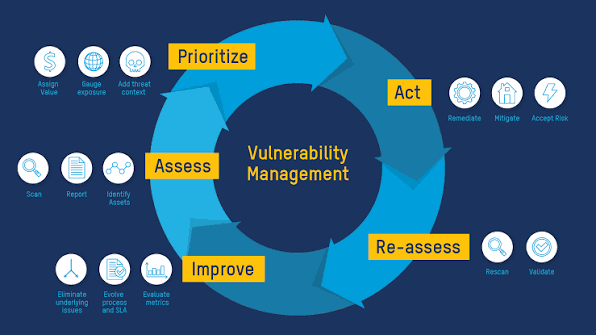
A typical vulnerability management process involves several important stages.
1. Discover and Identify Assets
The first step is understanding what needs protection. Businesses can identify servers, computers, applications, databases, cloud resources, network devices, and other connected assets.
Without an accurate asset inventory, important systems may be overlooked during security assessments.
2. Scan for Vulnerabilities
Security teams can use vulnerability scanning tools to identify known weaknesses in systems and applications. These tools can detect outdated software, missing security updates, configuration problems, and other potential vulnerabilities.
Regular scanning is important because an organization’s technology environment can change frequently.
3. Assess and Prioritize Risk
Not every vulnerability represents the same level of danger. Security teams should consider factors such as severity, exploitability, asset importance, exposure, and potential business impact.
High-risk vulnerabilities affecting critical systems generally require faster attention than lower-risk issues.
4. Remediate Vulnerabilities
After vulnerabilities are prioritized, organizations can take appropriate corrective action. This may involve applying security patches, updating software, changing configurations, removing vulnerable applications, or implementing additional security controls.
5. Verify the Results
After remediation, security teams should verify that the vulnerability has actually been resolved. Follow-up scans and security testing can help confirm whether the weakness remains present.
This creates a continuous cycle of identification, prioritization, remediation, and verification.
Vulnerability Management and Cybersecurity Risk
Vulnerability management plays an important role in reducing cybersecurity risk because it helps organizations focus resources on the weaknesses that could have the greatest consequences.
For example, an outdated application connected directly to the internet may require more immediate attention than a vulnerability affecting an isolated internal system. Risk-based prioritization allows security teams to make better use of limited time and resources.
Organizations can also combine vulnerability management with threat intelligence, endpoint security, network monitoring, and incident response to create a broader cybersecurity strategy.
The Role of Automation
As IT environments become larger, manually identifying and tracking vulnerabilities can become difficult. Automation can help security teams scan assets, identify vulnerabilities, generate reports, track remediation progress, and monitor changes.
Automated tools can improve efficiency, but human oversight remains important. Security professionals still need to evaluate business context and determine the appropriate response to individual vulnerabilities.
Best Practices for Vulnerability Management
Businesses can strengthen their vulnerability management programs by following several practices:
- Maintain an up-to-date inventory of IT assets
- Perform vulnerability assessments regularly
- Prioritize vulnerabilities according to risk
- Apply security patches promptly
- Monitor newly discovered vulnerabilities
- Verify that remediation actions are successful
- Limit unnecessary exposure of critical systems
- Keep vulnerability records organized
- Train employees on cybersecurity practices
- Continuously improve security processes
Conclusion
Vulnerability Management is a continuous cybersecurity practice that helps businesses identify weaknesses before they become serious security problems. By discovering vulnerabilities, assessing their risks, prioritizing remediation, and verifying fixes, organizations can improve their overall security posture.
As cyber threats and digital environments continue to change, businesses should treat vulnerability management as an ongoing process rather than a one-time security assessment. A structured and risk-based approach can help organizations reduce cybersecurity risk and build stronger protection for their systems and data.




Post Comment