Cyber Essentials vs Cyber Essentials Plus: Which One Offers Better Protection?

Cyber threats are becoming increasingly sophisticated, making cybersecurity a critical priority for businesses across the UK. Organizations need practical ways to protect their systems, devices, data, and customers from common online threats. Cyber Essentials vs Cyber Essentials Plus is therefore an important comparison for businesses deciding which certification can provide the right level of security assurance.
Although both certifications are based on the same fundamental cybersecurity controls, they differ in how compliance is assessed. Understanding these differences can help businesses choose the certification that matches their security needs, customer expectations, and risk profile.
What Is Cyber Essentials?
A UK government-backed cybersecurity certification program called Cyber Essentials was created to assist businesses in defending themselves against prevalent online dangers.
It focuses on five fundamental technical controls:
- Firewalls and network security
- Secure configuration
- Security update management
- User access control
- Malware protection
The certification provides businesses with a structured approach to identifying weaknesses and improving their basic cybersecurity practices.
For smaller businesses or organizations starting their cybersecurity journey, Cyber Essentials can be a practical first step.
What Is Cyber Essentials Plus?
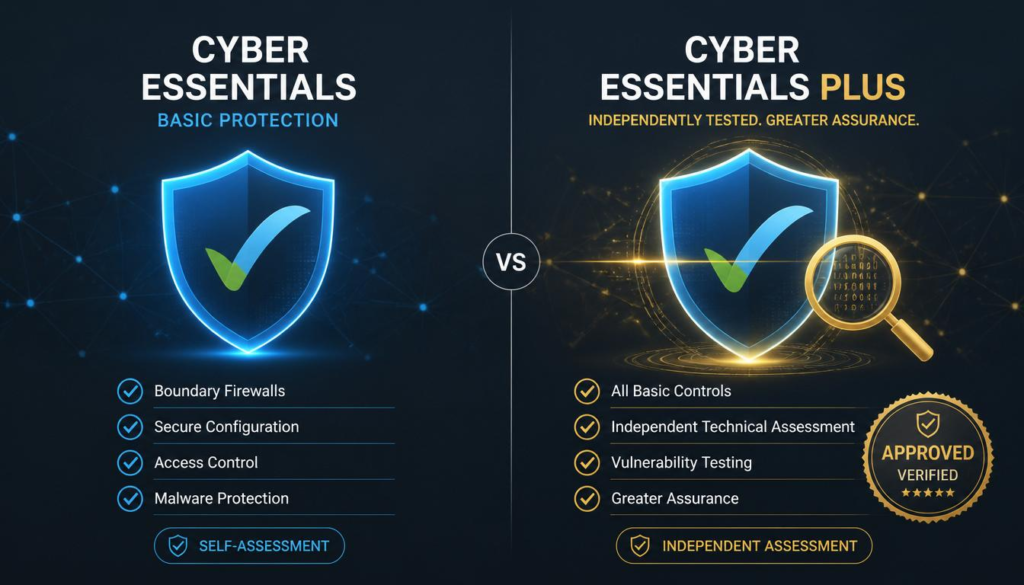
Cyber Essentials Plus includes the same core technical controls as Cyber Essentials but adds independent technical verification.
Instead of relying solely on an organization’s self-assessment, Cyber Essentials Plus involves an independent assessment of the organization’s systems and security controls. This provides greater assurance that the required protections are actually implemented and functioning effectively.
As a result, Cyber Essentials Plus is generally considered the higher-assurance certification.
Cyber Essentials vs Cyber Essentials Plus: Key Difference
The biggest difference between the two certifications is the assessment process.
| Feature | Cyber Essentials | Cyber Essentials Plus |
| Self-assessment | Yes | Yes |
| Five core technical controls | Yes | Yes |
| Independent technical testing | No | Yes |
| Level of assurance | Basic | Higher |
| Suitable for improving baseline security | Yes | Yes |
| Suitable for organizations needing stronger assurance | Sometimes | Yes |
The important point is that Cyber Essentials Plus does not replace the fundamental principles of Cyber Essentials. Instead, it adds independent testing to provide stronger evidence that those controls are working.
What Security Areas Do They Cover?
Both certifications focus on protecting an organization’s technology against common cyber risks.
1. Firewalls and Network Security
Firewalls help control traffic entering and leaving business networks. Proper network security can reduce the risk of unauthorized access and limit exposure to malicious activity.
Businesses should ensure that network devices are configured securely and unnecessary services are not exposed.
2. Secure Configuration
Secure configuration means setting up computers, servers, applications, and network devices with security in mind.
Organizations should remove unnecessary accounts, applications, and services where appropriate. Default passwords and insecure configurations should also be avoided.
3. Security Updates
Vulnerabilities in outdated software may be exploited by hackers. Regular security updates help organizations address known weaknesses.
Businesses should have processes for identifying, prioritizing, and applying relevant security updates across supported devices and software.
4. User Access Control
Not every employe requires access to every system used by the company. Access controls help ensure users receive only the permissions necessary for their responsibilities.
Strong authentication and appropriate account management can further reduce the risk of unauthorized access.
5. Malware Protection
Businesses need safeguards against malicious software that can damage systems, steal information, or disrupt operations.
Security software, appropriate configuration, controlled application use, and employee awareness can all contribute to stronger protection.
Why Does Cyber Essentials Matter?
Cyber Essentials provides businesses with a structured cybersecurity baseline.
Rather than attempting to solve every possible cybersecurity problem at once, organizations can start by addressing common weaknesses that attackers frequently target.
The certification can also help businesses demonstrate that they take cybersecurity seriously when dealing with customers, suppliers, partners, and other organizations.
Why Choose Cyber Essentials Plus?
Cyber Essentials Plus offers an additional layer of assurance through independent testing.
This can be particularly valuable for organizations where customers, contracts, supply chains, or internal risk management require stronger evidence of cybersecurity controls.
Independent testing can identify issues that may not be obvious during a self-assessment. Therefore, businesses can gain a clearer understanding of whether their security controls are operating effectively.
Cyber Essentials vs Cyber Essentials Plus: Which Provides Better Protection?
When comparing Cyber Essentials vs Cyber Essentials Plus, Cyber Essentials Plus generally provides greater assurance because it includes independent technical testing.
However, this does not mean that Cyber Essentials is ineffective. Cyber Essentials establishes important baseline protections and can help organizations address common security weaknesses.
The key difference is the level of verification.
Cyber Essentials:
Provides a baseline cybersecurity framework and self-assessment.
Cyber Essentials Plus:
Builds on that framework with independent technical verification.
Therefore, organizations seeking stronger evidence that their security controls work in practice may prefer Cyber Essentials Plus.
Benefits of Cyber Essentials
Businesses can gain several benefits from Cyber Essentials, including:
- A structured approach to basic cybersecurity
- Identification of common security weaknesses
- Improved security awareness
- Better protection against common cyber threats
- Demonstration of cybersecurity commitment
- Support for supplier and customer security requirements
It can also provide a foundation for developing a broader cybersecurity strategy.
Benefits of Cyber Essentials Plus
Cyber Essentials Plus provides the benefits of the Cyber Essentials framework while adding independent assessment.
Key advantages include:
- Greater confidence in security controls
- Independent technical verification
- Identification of security weaknesses
- Stronger evidence for customers and partners
- Improved understanding of the organization’s security posture
- Higher assurance than self-assessment alone
This extra guarantee might be especially helpful for companies that handle sensitive data or work in supply chains that are security-conscious.
Is Cyber Essentials Plus Worth It?
Whether Cyber Essentials Plus is worthwhile depends on the organization’s circumstances.
A business should consider factors such as:
- The sensitivity of its data
- Its cybersecurity risk profile
- Customer requirements
- Contractual obligations
- Supply-chain expectations
- Existing security controls
- Business size and technical environment
For some organizations, Cyber Essentials may provide an appropriate starting point. Others may benefit from the additional assurance offered by Cyber Essentials Plus.
How to Prepare for Certification
Businesses can improve their readiness by reviewing their technology environment before starting the certification process.
Step 1: Identify Your Devices
Create an accurate inventory of computers, servers, network equipment, mobile devices, and other relevant technology.
Step 2: Review User Accounts
Check whether employees have appropriate access permissions. Remove unnecessary accounts and reduce excessive privileges where possible.
Step 3: Check Software Updates
Make sure supported operating systems and applications are receiving appropriate security updates.
Step 4: Review Network Security
Examine firewalls, routers, wireless networks, and remote access arrangements to identify potential weaknesses.
Step 5: Improve Secure Configuration
Review device and software configurations and remove unnecessary services, applications, or accounts.
Step 6: Test Your Security
Organizations considering Cyber Essentials Plus should prepare for independent technical testing by addressing obvious vulnerabilities before assessment.
Common Mistakes Businesses Should Avoid
Businesses can sometimes focus too heavily on obtaining certification instead of building sustainable cybersecurity practices.
Common mistakes include:
- Treating cybersecurity as a one-time project
- Failing to maintain software updates
- Giving users unnecessary privileges
- Ignoring older devices and applications
- Not keeping an accurate asset inventory
- Assuming certification eliminates all cyber risks
- Failing to provide employee security awareness training
Certification should be viewed as part of an ongoing cybersecurity strategy rather than the final destination.
Cyber Essentials vs Cyber Essentials Plus: Final Verdict
The choice between Cyber Essentials vs Cyber Essentials Plus depends on the level of assurance your organization needs.
Cyber Essentials is a useful baseline certification for organizations looking to establish fundamental cybersecurity controls and demonstrate their commitment to security.
Cyber Essentials Plus goes further by independently testing those controls, giving businesses stronger assurance that their security measures are functioning effectively.
For organizations that require higher confidence, particularly those with demanding customers, contracts, or supply-chain requirements, Cyber Essentials Plus may be the stronger choice.
Ultimately, both certifications can play an important role in improving cybersecurity. The best option is the one that matches your organization’s risks, requirements, and long-term security strategy.




Post Comment