AI Governance Workflow for New AI Tools: A Complete Guide
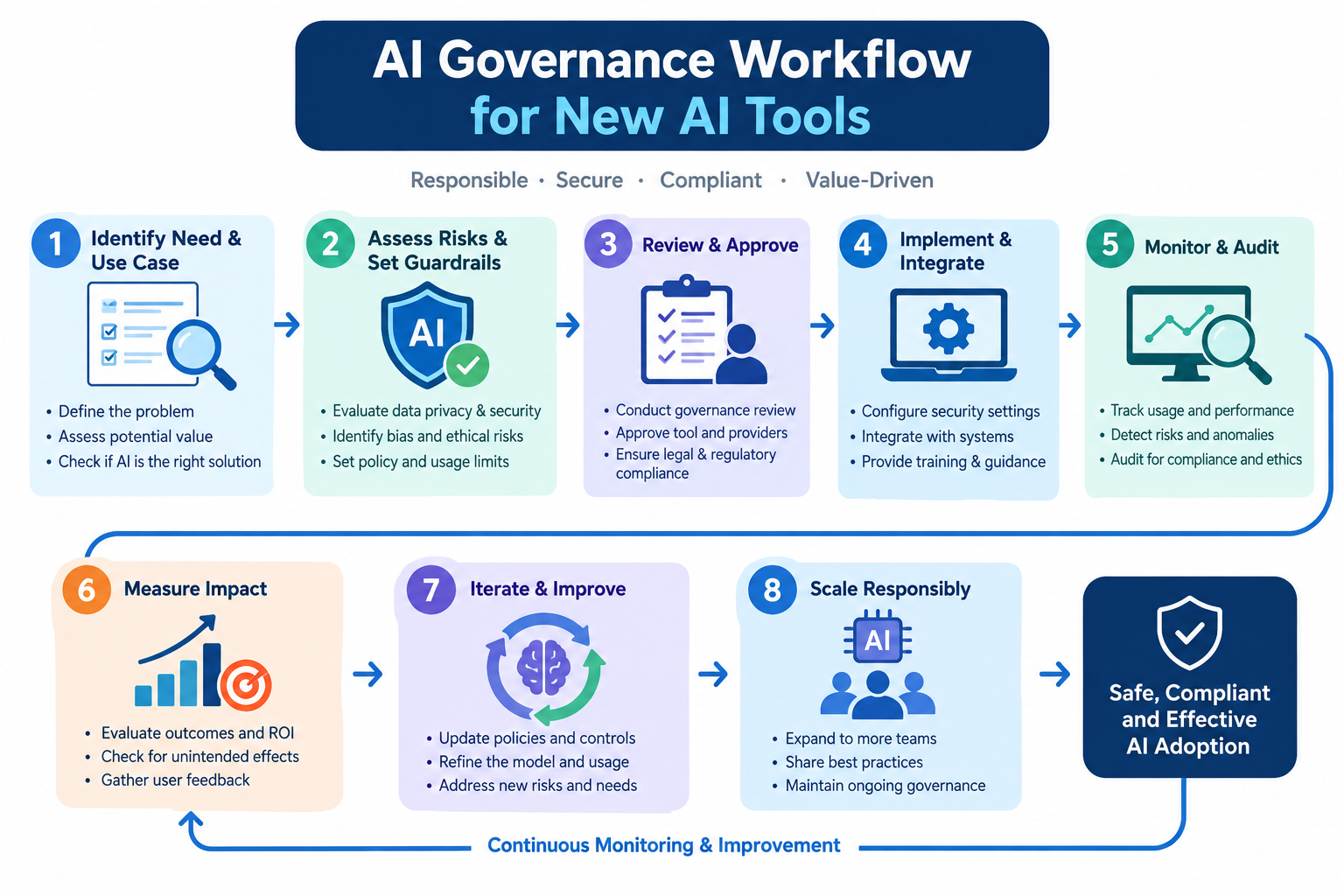
AI Governance Workflow for New AI Tools is becoming part of everyday business operations, from customer service and marketing to data analysis, software development, and decision-making. As organizations adopt more AI tools, they also face new challenges involving privacy, security, compliance, accuracy, and responsible use.
A well-designed AI governance workflow for new AI tools helps businesses evaluate, approve, monitor, and manage AI solutions before they become part of regular operations. Instead of allowing employees to adopt AI tools without oversight, organizations can use a structured workflow that balances innovation with risk management.
What Is an AI Governance Workflow?
An AI governance workflow is a structured process for deciding how an organization evaluates and manages artificial intelligence tools and use cases.
The workflow typically covers:
- AI tool or use-case identification
- Risk assessment
- Data and privacy review
- Security evaluation
- Legal and compliance checks
- Approval and deployment
- Employee training
- Ongoing monitoring
- Periodic reassessment
The objective is not to prevent employees from using AI. Instead, good governance creates a framework that allows organizations to adopt useful AI technologies while reducing unnecessary risks.
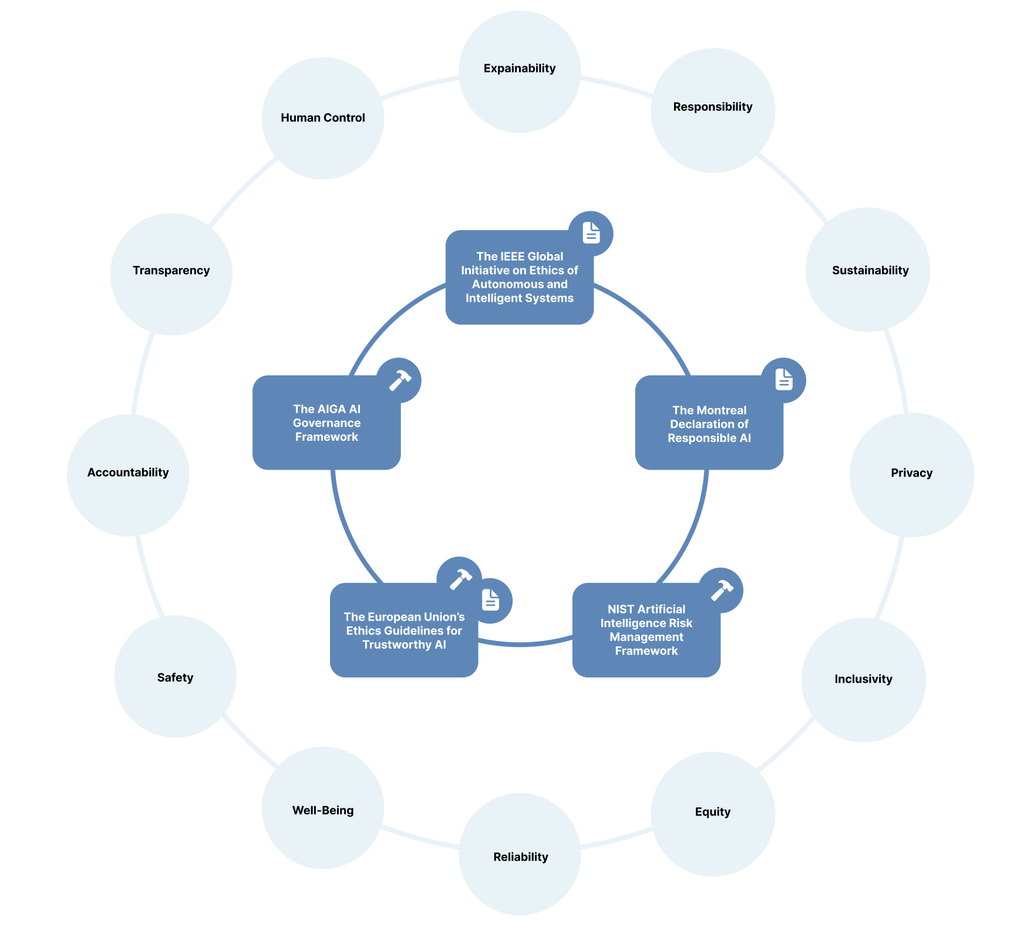
Why AI Governance Matters for New AI Tools
New AI applications can introduce risks that are not immediately obvious. A free AI writing assistant, for example, might seem harmless until employees enter confidential business information into it.
Similarly, an AI analytics platform could produce inaccurate recommendations, while an automated decision-making system could create fairness or compliance concerns.
An AI governance workflow helps organizations answer important questions before deployment:
- What does the AI tool actually do?
- What information does it collect?
- Where is company data processed?
- Who can access the information?
- Is sensitive data involved?
- How reliable are the AI-generated results?
- Does the tool meet internal policies?
- What risks could occur if the system makes a mistake?
- Who is responsible for monitoring the tool?
Step 1: Identify the AI Tool or Use Case
The first stage is to document every proposed AI tool or AI-powered business use case.
The request should include basic information such as:
- Tool or vendor name
- Business department
- Intended purpose
- Users
- Type of AI technology
- Data involved
- Expected benefits
- Integration requirements
- Estimated cost
For example, a marketing team may request an AI content-generation platform to create initial drafts. A finance department may request an AI system to analyze business reports.
Documenting the use case makes it easier for governance teams to determine the appropriate level of review.
Step 2: Classify the AI Risk
Not every AI tool requires the same level of scrutiny. Organizations should classify AI applications according to their potential impact.
A simple framework could include:
Low Risk
Examples include:
- Brainstorming tools
- General writing assistants
- Meeting summarization
- Basic productivity applications
These tools may require basic security and privacy checks.
Medium Risk
Examples include:
- Customer analytics
- Business forecasting
- AI-powered recruitment assistance
- Internal decision-support systems
These applications usually require additional data, security, and human oversight reviews.
High Risk
Examples may include:
- Automated decisions affecting individuals
- Systems processing highly sensitive information
- AI used in regulated environments
- Critical operational systems
High-risk applications should receive detailed technical, legal, security, and compliance assessments before approval.
Step 3: Review Data and Privacy Requirements
Data governance is one of the most important parts of AI adoption.
Before approving an AI tool, organizations should determine what information the system receives and how that information is processed.
Questions to consider include:
- Does the tool store user prompts?
- Is business information used to train models?
- Where is data stored?
- Can third parties access the information?
- How long is data retained?
- Can users delete their information?
- Does the provider offer appropriate privacy controls?
Employees should also understand what information they are allowed to enter into AI systems.
For example, organizations may prohibit employees from entering passwords, confidential contracts, customer records, financial information, or other sensitive business data into unapproved AI platforms.
Step 4: Perform a Security Assessment
AI tools should also go through an appropriate cybersecurity review.
Security teams can evaluate:
- Authentication
- Access controls
- Encryption
- Data storage
- API security
- Vendor security practices
- Integration risks
- Incident response procedures
- Third-party dependencies
If an AI application connects directly to internal systems, the security review becomes even more important.
An AI tool that can access company databases, cloud storage, email systems, or customer platforms should have clearly defined permissions.
Step 5: Evaluate Legal and Compliance Requirements
Organizations should determine whether the proposed AI use case creates legal or regulatory obligations.
The review may involve:
- Data protection requirements
- Intellectual property concerns
- Industry regulations
- Contractual obligations
- Consumer protection requirements
- Employment considerations
- AI-specific regulations
Legal teams do not necessarily need to review every low-risk AI application manually. Instead, organizations can create predefined rules that identify which use cases require formal legal review.
Step 6: Evaluate AI Accuracy and Reliability
AI systems can produce incorrect, incomplete, outdated, or misleading information.
Therefore, governance should include an evaluation of the system’s reliability.
Organizations can test:
- Accuracy
- Consistency
- Hallucination risk
- Bias
- Explainability
- Performance across different scenarios
For important business decisions, AI outputs should generally be treated as decision-support information rather than automatically accepted as fact.
Human review remains particularly important when mistakes could create financial, legal, operational, or reputational consequences.
Step 7: Approve, Reject, or Request Changes
After completing the required assessments, the organization can make a decision.
A simple approval structure could include:
Approved: The tool meets organizational requirements.
Approved with conditions: The tool can be used but must follow specific restrictions.
Requires changes: The vendor or internal team must address identified risks before deployment.
Rejected: The risks are too significant or the tool does not meet organizational requirements.
This approach prevents governance from becoming a simple yes-or-no process.
Step 8: Create an AI Tool Inventory
Every approved AI system should be recorded in an organizational AI inventory.
The inventory could include:
| Information | Example |
| AI Tool | Enterprise AI Assistant |
| Department | Marketing |
| Purpose | Content research |
| Risk Level | Medium |
| Data Type | Internal business information |
| Owner | Marketing Operations |
| Approval Date | September 2026 |
| Review Date | March 2027 |
| Status | Approved |
An AI inventory provides visibility into the organization’s overall AI environment and makes future audits easier.
Step 9: Define Usage Policies
Approval alone is not enough. Employees need clear instructions about how an AI tool can be used.
An AI usage policy might explain:
- Which tools are approved
- What information can be entered
- What information is prohibited
- When human review is required
- How AI-generated content should be checked
- Who employees should contact when problems occur
Clear policies reduce the risk of employees accidentally using AI in unsafe ways.
Step 10: Train Employees
Employees are an essential part of AI governance.
Training should explain practical issues rather than focusing only on technical concepts.
Employees should understand:
- AI limitations
- Data privacy
- Security risks
- Prompt safety
- Accuracy verification
- Approved AI tools
- Responsible AI use
- Reporting procedures
Short, practical training sessions can be more effective than complicated policy documents that employees rarely read.
Step 11: Monitor AI Tools After Deployment
AI governance should continue after an application has been approved.
Organizations should monitor:
- Security incidents
- Data usage
- AI performance
- Unexpected outputs
- User complaints
- Vendor changes
- Policy violations
- Changes in regulatory requirements
A tool that was considered low risk when initially approved could become more significant after new features, integrations, or business uses are introduced.
Step 12: Conduct Regular Reviews
AI tools should be reassessed periodically.
A review schedule could depend on the risk level:
- Low-risk tools: annual review
- Medium-risk tools: six-month review
- High-risk tools: more frequent monitoring
Organizations should also trigger an additional review when:
- The vendor changes its terms
- The AI model changes significantly
- New data is introduced
- The tool gains new permissions
- The business use case changes
- A security incident occurs
- New regulations affect the use case
A Simple AI Governance Workflow
A practical workflow can be summarized as:
AI Request → Risk Classification → Data Review → Security Review → Legal Review → Testing → Approval → Deployment → Monitoring → Periodic Review
This structure can be adapted to organizations of different sizes.
Small businesses may combine several review stages, while large enterprises may have separate teams for security, privacy, legal, compliance, and responsible AI.
How to Make AI Governance More Efficient
AI governance does not have to become a major administrative burden.
Organizations can improve efficiency by creating standardized processes.
Use an AI Intake Form
Create one form for employees to submit new AI tools or use cases.
Create Risk-Based Reviews
Do not apply the same approval process to every AI application. Use a tiered approach based on potential risk.
Maintain an Approved Tools List
Employees should easily know which AI applications are already approved.
Automate Governance Tasks
Workflow automation can help with:
- Approval notifications
- Review reminders
- Risk questionnaires
- Inventory updates
- Policy acknowledgments
- Compliance documentation
Assign Clear Ownership
Every AI application should have a business owner responsible for its appropriate use and ongoing review.
Common AI Governance Mistakes
Organizations often make several mistakes when introducing AI governance.
1. Blocking AI Completely
Completely banning AI can encourage employees to use unauthorized tools without informing IT or security teams.
2. Approving Tools Without Understanding Data Risks
A tool may appear useful but create privacy or confidentiality problems if sensitive information is processed.
3. Focusing Only on Security
Cybersecurity is important, but governance should also consider privacy, accuracy, compliance, ethics, and business impact.
4. Forgetting Human Oversight
AI systems should not automatically control important decisions without appropriate human review.
5. Failing to Update the AI Inventory
An outdated inventory can make it difficult to understand which AI systems are actually being used across an organization.
AI Governance Workflow Checklist
Before approving a new AI tool, organizations can use this checklist:
- Identify the AI tool and business purpose
- Identify the responsible business owner
- Classify the risk
- Review the data being processed
- Conduct a privacy assessment
- Conduct a security assessment
- Check legal and compliance requirements
- Test accuracy and reliability
- Define usage restrictions
- Approve or reject the application
- Add the tool to the AI inventory
- Train relevant employees
- Monitor performance and risks
- Schedule the next review
Final Thoughts
An effective AI governance workflow for new AI tools gives organizations a practical way to adopt artificial intelligence without ignoring security, privacy, compliance, and operational risks.
The most successful approach is not to slow down innovation but to make AI adoption more structured. By combining risk classification, data reviews, security assessments, human oversight, employee training, and continuous monitoring, businesses can create a safer environment for AI experimentation and deployment.
As AI technology continues to evolve, governance workflows should evolve with it. A flexible, risk-based process can help organizations take advantage of new AI capabilities while maintaining responsible control over how these technologies are used.




Post Comment